

It is a paradox of the acquisitive society in which we now live that although private morals are regulated by law, the entrepreneur is allowed considerable freedom to use - and abuse - the public in order to make money.
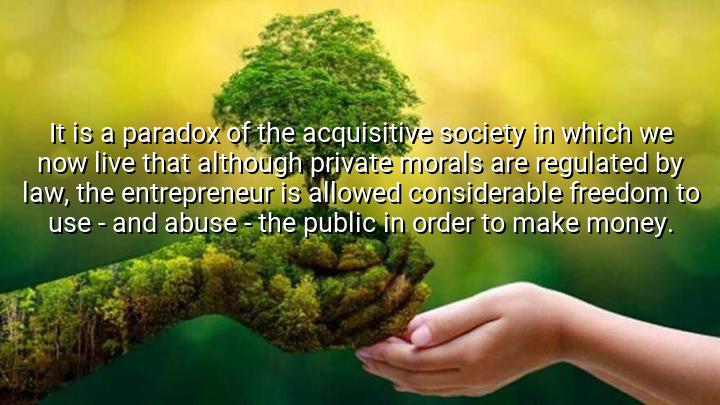




In this quote, Gore Vidal critiques the contradictions inherent in modern society, particularly in relation to the regulation of morality and the economic system. He points out that while private morals are often strictly regulated by law, entrepreneurs are granted significant freedom in their business practices, even if those practices may exploit or abuse the public for personal gain. Vidal highlights a paradox where the moral actions of individuals are controlled by the state, but the freedom to profit at the expense of others is largely unchecked.
Vidal's statement suggests that modern capitalism allows entrepreneurs to operate with little ethical restraint, focusing on profit rather than the well-being of society. He points out the discrepancy between the moral regulations placed on individuals in their personal lives and the liberties granted to those who control economic power. This freedom to exploit the public for financial gain underscores what Vidal sees as an imbalance between individual rights and corporate interests.
The quote challenges the idea of capitalism as a fair system, calling attention to the ways in which it can enable corporations and business leaders to prioritize their own financial success over the needs and rights of consumers. Vidal’s critique is rooted in his broader skepticism of economic systems that, in his view, place more value on profits than on ensuring the fair treatment of individuals in society.
Ultimately, Vidal’s words reveal his concern about the moral implications of modern capitalism, particularly the idea that business leaders are allowed to engage in potentially harmful practices without adequate regulation or oversight. He points to the paradox in which individuals are bound by strict moral laws, while those in positions of economic power are granted freedoms that can often lead to exploitation.

AAdministratorAdministrator
Welcome, honored guests. Please leave a comment, we will respond soon