

It is a golden maxim to cultivate the garden for the nose, and the eyes will take care of themselves.
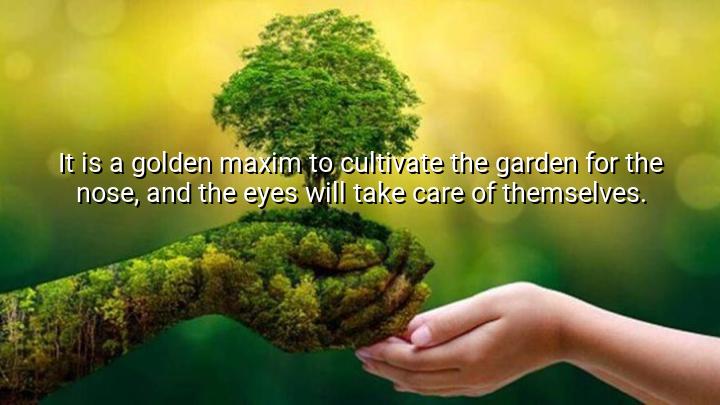




The quote by Robert Louis Stevenson, "It is a golden maxim to cultivate the garden for the nose, and the eyes will take care of themselves," speaks to the idea that true enjoyment and satisfaction in gardening come from the sensory experiences it offers, particularly through smell. Stevenson suggests that by focusing on planting and cultivating for fragrance—rather than purely for visual appeal—one can create a garden that is both beautiful and pleasing in a deeper, more meaningful way. The idea is that by enriching the senses, especially the sense of smell, the visual beauty will naturally follow.
Stevenson’s quote emphasizes the importance of engaging with the garden on a more sensory level, suggesting that when we design spaces that engage multiple senses, the overall experience becomes richer and more fulfilling. The nose, being tied to the sense of smell, offers a more intimate connection to nature, inviting us to engage with the garden in a personal, almost spiritual way. As we nurture plants for their fragrance, the visual beauty of the garden will naturally complement that, creating a balanced sensory experience.
This perspective also highlights the broader idea of simplicity and natural beauty. Instead of focusing on making the garden look perfect or follow rigid aesthetics, Stevenson encourages us to create spaces that reflect the deeper essence of nature, which can be experienced through sight, smell, and even touch. The quote implies that by attending to the less obvious aspects of the garden, such as fragrance, we are creating an environment that is not only more authentic but also more satisfying in ways that are not always visible at first glance.
The origin of this quote reflects Robert Louis Stevenson’s love for nature and his exploration of human sensory experiences. Known for his literary works, including Treasure Island and The Strange Case of Dr. Jekyll and Mr. Hyde, Stevenson also wrote about the human connection to the natural world. His reflections on gardening and sensory pleasure capture his belief in the power of nature to offer a more holistic and fulfilling experience, one that transcends just what we can see with our eyes.

AAdministratorAdministrator
Welcome, honored guests. Please leave a comment, we will respond soon