

Is education possibly a process of trading awareness for things of lesser worth? The goose who trades his is soon a pile of feathers.
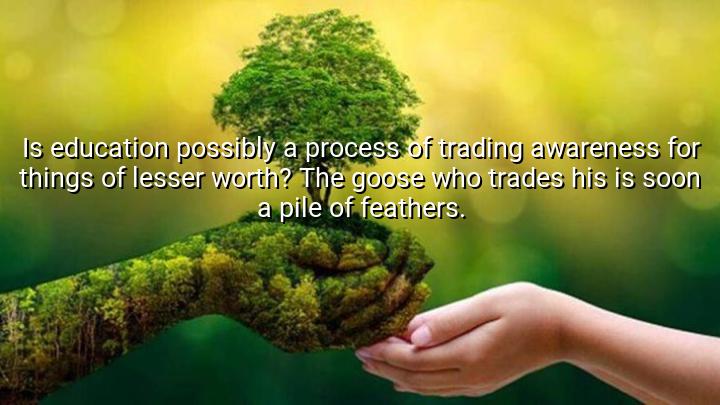




The quote by Aldo Leopold raises a critical question about the true purpose of education. Leopold asks whether the process of learning can sometimes result in exchanging genuine awareness—insight, critical thinking, or environmental consciousness—for things of lesser value, such as superficial knowledge, conformity, or material gain. The metaphor of the goose trading his awareness emphasizes that losing true perception or understanding can leave one depleted, much like a goose reduced to a pile of feathers.
Leopold’s statement suggests that education should nurture deeper awareness rather than merely imparting facts or training people to fit into existing systems. When learning focuses solely on rote memorization, credentialism, or utilitarian skills, it risks diminishing the individual’s capacity for meaningful insight, judgment, and ethical reasoning. The warning is that without critical awareness, education may do more harm than good.
The origin of this quote is from Aldo Leopold (1887–1948), an American ecologist, forester, and environmentalist, best known for his book A Sand County Almanac. Leopold frequently reflected on the relationship between humans and nature, advocating for a land ethic and a conscious awareness of environmental and social responsibilities. This quote reflects his concern that modern education can sometimes neglect moral and ecological awareness in favor of less significant pursuits.
Ultimately, this quote reminds readers that education should cultivate critical thinking, ethical understanding, and environmental awareness. It encourages reflection on the values being taught and challenges educators and learners to ensure that knowledge enhances insight and consciousness rather than merely serving trivial or superficial ends.

AAdministratorAdministrator
Welcome, honored guests. Please leave a comment, we will respond soon