

In June as many as a dozen species may burst their buds on a single day. No man can heed all of these anniversaries; no man can ignore all of them.
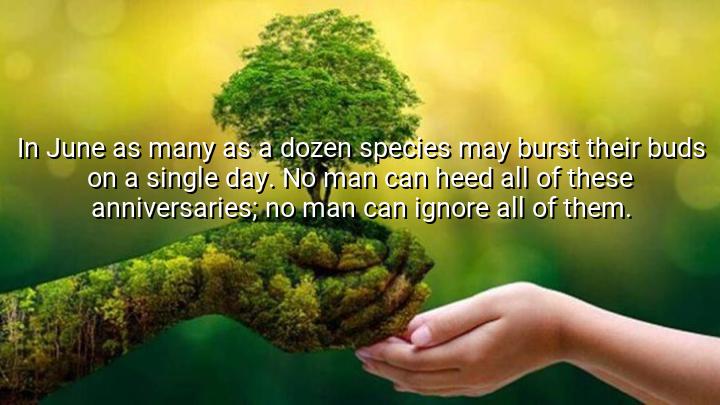




In this quote, Aldo Leopold reflects on the prolific nature of life, particularly in June, when many species may burst into bloom on the same day. He draws a parallel between the natural world and the human experience, suggesting that just as we cannot attend to every single occurrence in nature, such as the blooming of all these species, we also face a balance in how we navigate the many anniversaries and events in our lives. The quote highlights the tension between the overwhelming nature of life's milestones and the importance of acknowledging those that truly matter.
Leopold’s statement also speaks to the concept of prioritization in human life. There are countless events, anniversaries, and responsibilities we encounter, and it’s impossible to give full attention to every single one. However, he argues that while no one can heed every anniversary, it is also important not to ignore them entirely. This suggests that there is a need to find balance and meaning in our responses to life's regular occurrences and personal milestones.
The origin of the quote comes from Aldo Leopold, an American ecologist, forester, and environmentalist, widely regarded for his work on land ethics and his deep understanding of nature. His perspective often emphasized the interconnectedness of humans and the environment. In this quote, he uses the flourishing of species in nature as a metaphor for the complexity and multiplicity of human experiences and commitments.
Ultimately, Leopold’s quote serves as a reminder to find harmony in our response to the numerous anniversaries and significant moments in life. While it may not be possible to focus on all of them, we should strive to recognize and honor those that carry true meaning for us, just as we must acknowledge the richness of nature’s cycles without being overwhelmed by them.

TVVõ Tuòng Vy
I’m struck by the idea that no one can ignore all these natural ‘anniversaries.’ Does this imply that, consciously or not, we are connected to nature’s rhythms? How might modern life, often detached from natural cycles, affect this connection? It’s worth exploring how seasonal changes and ecological events influence human wellbeing and cultural practices.
NNNguyen Nhi
The imagery of multiple species bursting buds at once feels like a celebration of life’s richness and diversity. Yet, it also reminds me of the limits of human perception. Can technology or education help us ‘heed’ more of these natural anniversaries, or is some mystery meant to remain? This quote inspires a dialogue on conservation and respect for nature’s myriad cycles.
UGUser Google
This statement highlights a tension between the abundance of natural events and our limited capacity to attend to them all. Does this suggest a humility we should adopt in the face of nature’s complexity? Also, how do we decide which moments deserve our attention, and what are we missing when we ignore others? It’s an invitation to reflect on how we prioritize awareness in our daily lives.
QVLe Nguyen Quoc Viet
I find this idea fascinating—that so many species simultaneously experience important life events we might miss. Is this a metaphor for the many unnoticed but meaningful occurrences in life? How does this relate to human celebrations and memories? It prompts me to think about the difference between human-made anniversaries and natural ones, and what we can learn from nature’s timing.
GNgia nhi
This quote beautifully captures nature’s rhythm and the countless moments worth noticing. It makes me wonder how often we overlook the small ‘anniversaries’ in nature because we’re too busy or distracted. How can we cultivate greater awareness and appreciation for these natural cycles? It also raises the question of whether recognizing such moments can deepen our connection to the environment and inspire more mindful living.