

Information is the oxygen of the modern age. It seeps through the walls topped by barbed wire, it wafts across the electrified borders.
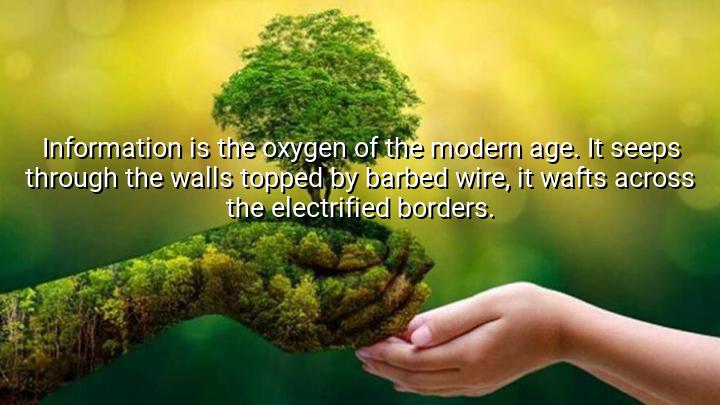




In this quote, Ronald Reagan emphasizes the importance of information in the modern world, comparing it to oxygen, a vital element for survival. By stating that information is the "oxygen of the modern age," Reagan suggests that, just as we cannot live without air, societies and individuals cannot thrive without access to information. He underscores the idea that in today's world, information has become indispensable for growth, understanding, and progress.
Reagan further highlights the ubiquity and power of information by describing how it penetrates even the most restricted environments. He says it "seeps through the walls topped by barbed wire" and "wafts across the electrified borders," alluding to the ways in which information can transcend physical and political barriers, such as the ones that existed during the Cold War. His words speak to the revolutionary effect of information in breaking down oppression and isolation—even regimes or countries that try to keep information out can no longer fully control its spread.
This quote also reflects the shift in global dynamics during Reagan's presidency, particularly in the context of the Cold War. At the time, the United States and the Soviet Union were locked in ideological and political conflict, with information being a key battleground. Reagan's words imply that the freedom of information can challenge oppressive systems, as people exposed to diverse ideas can question authoritarian rule, ultimately leading to greater societal change.
Ultimately, Ronald Reagan's quote highlights the transformative power of information in the modern world, making it a vital force that transcends borders and challenges control. His analogy to oxygen underscores the fundamental role that information plays in maintaining both personal freedom and global stability, and how its reach and influence continue to reshape the world.

TNPhat Trien Nha
It’s fascinating to reflect on how prophetic this quote sounds. In a time when borders matter less to data than ever before, information truly does move like air. But how do we reconcile this freedom with the need for boundaries—ethical, cultural, or factual? Has the openness of information eroded our sense of truth, or is that just part of adapting to a modern, connected age?
NGNZ G
This quote is quite inspiring in a Cold War context, where controlling information was a tool of oppression. It’s easy to see how it symbolized hope for people behind closed borders. But in today’s digital world, where surveillance and data manipulation are rampant, is information still a tool for freedom? Or has it also become a means of control in itself?
HHPhung Tran Huy Hai
Reagan’s words seem especially relevant today, but I wonder if they’ve aged as optimistically as intended. Information flows freely now, yes—but it also overwhelms, deceives, and divides. Are we more informed or just more distracted? If information is oxygen, are we breathing clean air, or have we polluted the very thing meant to sustain us?
TATri Anh
I find this metaphor striking—equating information to oxygen really captures its necessity in our lives. But I’m also left questioning whether access to information alone is enough to bring about change. In oppressive regimes or manipulated media environments, doesn’t it also matter how people interpret and act upon the information they receive? What empowers people more: the flow of information or their capacity to use it wisely?
CHNgo Chan Hung
This quote makes me wonder—can information still be that liberating force in an age where misinformation spreads just as easily? It’s true that information can cross barriers, but the sheer volume and unreliability of what’s out there today seem to dilute its power. Do we need to start thinking more about the *quality* of the information we consume, not just the fact that we have access to it everywhere?