

In youth, the days are short and the years are long. In old age, the years are short and days long.
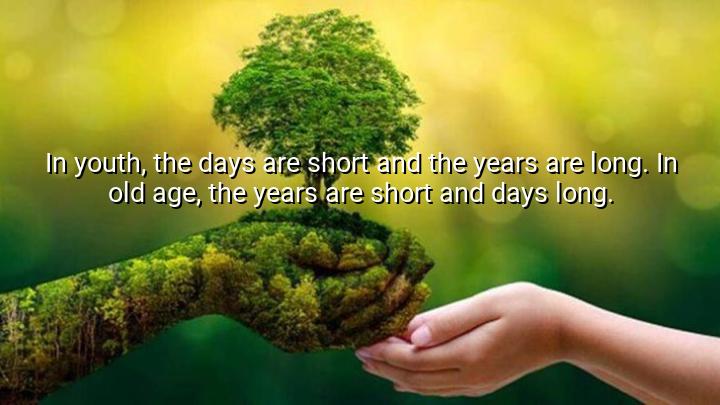




Pope Paul VI’s quote, "In youth, the days are short and the years are long. In old age, the years are short and days long," captures the contrasting perceptions of time that change as we age. In youth, time often feels abundant, and we experience the days as fleeting. The years seem long because youth is a time of growth, exploration, and new experiences, which often feel like they stretch on, giving a sense of endless potential. Each day might feel quick, but the years ahead seem filled with possibilities and opportunities.
As we transition into old age, the perception of time shifts dramatically. Old age brings reflection, wisdom, and a certain slowing down of life. In this phase, years seem to pass more quickly, as the rapid pace of life slows, and we often find ourselves reflecting on the moments that have already passed. The days, on the other hand, can feel longer because there are fewer new experiences or fewer significant milestones. The routine of daily life can make time seem to drag as we age, despite the overall sense that the years are moving too quickly.
This quote underscores how our relationship with time changes with age. As children or young adults, the future seems vast and full of endless possibilities, making the years seem to stretch on. However, as we grow older, time becomes more precious, and the feeling of time slipping away can become more prominent, leading to a feeling of days dragging on despite the years passing quickly.
Pope Paul VI's quote emphasizes the cyclical and subjective nature of time, illustrating how our emotional and psychological experiences shape our perception of it. It encourages us to reflect on how we spend our time at different stages of life and reminds us of the fleeting nature of both youth and old age, urging us to live each moment with mindfulness and appreciation.

BTNguyẽn Bảo Thy
The duality in this quote really stands out to me. It’s fascinating how something as constant as time can feel so different depending on where we are in life. Is this perspective a result of our changing priorities? As kids, we're focused on fun and freedom. As adults, responsibilities and routines take over. Maybe it’s not time itself that changes, but our relationship with it. How can we keep time feeling meaningful throughout life?
TKnguyen trong khoi
This quote hits close to home. I used to think older people were exaggerating when they said time speeds up with age, but now I see it happening to me. Do you think this shift in how we perceive time contributes to feelings of regret or nostalgia in later life? And if so, is it more important to make peace with the past or to focus on finding joy in the slowness of the present?
MHLe Minh Huong
Such a poignant observation. I wonder—does this mean we value time differently at different stages of life? In youth, we rush through the hours, chasing the future. In age, we savor each day, possibly because we know the years are slipping away faster. Is there a way to find balance in our perception of time, to hold on to the appreciation of each day without needing to reach old age first?
TATran Tu Anh
I find this quote oddly comforting and a little melancholic. It captures the irony of time’s passage beautifully. When we’re young, we're too impatient to realize how fast everything will go. In later years, we might have the hours but not the energy. Is this a reminder to be more present at every age? And if so, how do we actually apply that in a culture obsessed with productivity?
HKHang Khach
This quote makes me reflect on how our perception of time shifts as we age. As a teenager, a summer felt endless, but now a year goes by in a flash. Do you think this change in perception is just about age, or does it have more to do with how we spend our time? Maybe our experiences become more repetitive or less novel as we grow older, affecting our sense of time’s pace.