

In this media-drenched, multitasking, always-on age, many of us have forgotten how to unplug and immerse ourselves completely in the moment. We have forgotten how to slow down. Not surprisingly, this fast-forward culture is taking a toll on everything from our diet and health to our work and the environment.
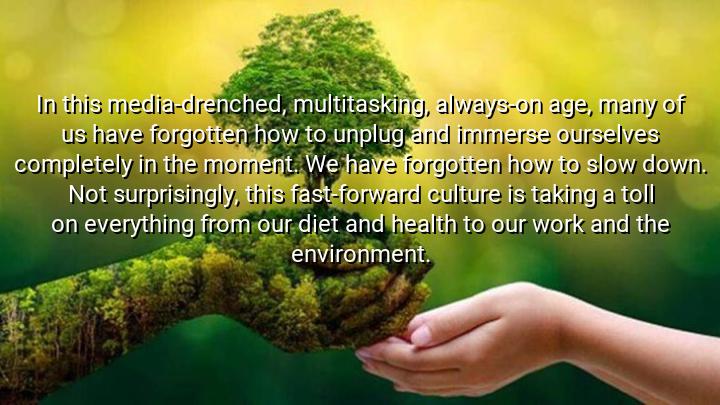




In this quote, Carl Honore, a Canadian journalist and author, reflects on the overwhelming pace of modern life in an era dominated by media, multitasking, and constant connectivity. He argues that in our always-on culture, many people have forgotten how to truly unplug and be present in the moment. Instead, we are often caught up in the rush of daily activities, failing to take the time to slow down and appreciate the world around us. Honore highlights how this fast-forward culture has become ingrained in our lives, leading us to neglect important aspects of well-being.
Honore suggests that the pressures of modern life, driven by technology and the constant demand for productivity, have a negative impact on several facets of life, including diet, health, work, and even the environment. The inability to slow down and disconnect from the constant noise of media and tasks leads to stress, poor lifestyle choices, and a lack of focus on the things that truly matter. This chaotic pace, according to Honore, is taking a toll on our physical and mental well-being, as well as our ability to make thoughtful decisions about the future of the environment.
The origin of this quote comes from Honore’s work on the concept of slow living, as explored in his book In Praise of Slow. In this book, Honore challenges the societal obsession with speed and productivity, urging people to embrace a more mindful and deliberate approach to life. His ideas reflect a growing movement that advocates for stepping away from the constant rush and taking time to enjoy simple pleasures and focus on personal and social well-being.
Ultimately, Honore’s words serve as a reminder of the importance of balance in our fast-paced, media-saturated world. The quote encourages us to recognize the value of slowing down, being present, and taking care of ourselves and the world around us. It calls for a shift in priorities, away from the relentless pace of modern life toward a more intentional and health-conscious way of living.

TVthanh van
Reading this made me think of how often I eat while scrolling or check emails during walks. It's like I’ve forgotten how to just... do one thing. The idea that our culture’s speed is harming not only our minds but the environment is really compelling. How does our addiction to instant gratification translate into things like waste, overconsumption, or burnout? Is learning to slow down actually a form of activism?
A802. Thuy An 8/8
Honestly, this quote stresses me out a bit—not because it’s wrong, but because it’s so accurate. I find it hard to unplug without feeling guilty. There’s this pressure to always be doing something productive or consuming content. But who decided that rest is wasteful? I’d love to know how others are reclaiming slowness in their lives. What does a meaningful pause look like in an age of acceleration?
TTHuynh tuan truong
I appreciate how this quote connects personal habits with broader impacts. It’s easy to see fast-paced living as an individual choice, but Honore reminds us that it has ripple effects—on our bodies, our jobs, even the environment. That connection really hit me. Are we consuming everything too quickly—from meals to news to natural resources? Maybe the change starts not with big policy, but with how we choose to spend each minute.
DTVu Dang Trinh
This quote makes me ask: have we lost the ability to be bored in a healthy way? That space where creativity and reflection come in? I feel like everything in my life is designed to keep me distracted and moving faster. But faster doesn’t always mean better. How do we push back against a culture that equates slowing down with failure? Is it possible to live meaningfully without being constantly 'on'?
NQMinh Nguyen Quang
Honore really gets to the heart of something I’ve been struggling with—this nonstop pace that leaves you exhausted but weirdly unproductive. We talk so much about efficiency, but at what cost? If our health, work quality, and the planet are suffering, isn’t it time to redefine what ‘productive’ even means? Maybe slowing down isn’t lazy—it’s the most responsible thing we can do for ourselves and the world.