

In this electronic age we see ourselves being translated more and more into the form of information, moving toward the technological extension of consciousness.
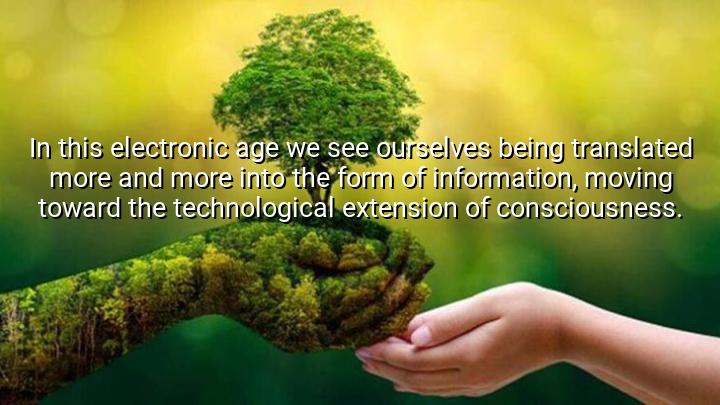




Marshall McLuhan’s quote, "In this electronic age we see ourselves being translated more and more into the form of information, moving toward the technological extension of consciousness," reflects his thoughts on how technology, especially electronic media, is changing the way we perceive ourselves and interact with the world. McLuhan, a Canadian philosopher and communication theorist, was particularly interested in how new media technologies like television, radio, and later computers, would reshape human consciousness. He suggests that, as we increasingly live through these technologies, we begin to express and understand ourselves more as information rather than physical beings.
The quote speaks to the way technology is becoming an integral part of our identity and self-expression. Information—such as through digital communication or data—becomes the primary medium through which we interact with the world, replacing traditional forms of interaction that were once more physical or direct. This shift represents a move toward a technological extension of our consciousness, where our thoughts, experiences, and even our identities are increasingly mediated by electronic devices.
McLuhan’s concept of the technological extension of consciousness refers to the idea that technology not only extends our physical capabilities (like transportation or communication) but also our mental and cognitive capacities. As electronic media evolve, they are changing how we process information and relate to the world, leading to a new form of awareness that is more influenced by digital devices and virtual spaces than by direct, personal experience. McLuhan’s work foresaw the way in which technologies like the internet would increasingly shape human cognition and social interaction.
In essence, McLuhan’s quote predicts how technology is reshaping human identity and consciousness. By transforming ourselves into digital information, we are becoming more connected and mediated by technology, affecting not only how we communicate but how we think, feel, and experience the world. His ideas remain highly relevant today, as we continue to integrate technology into every facet of life, from work to personal relationships to how we see ourselves in the digital age.

HLHa Linh
This quote captures the eerie feeling that we are no longer just physical beings but streams of data in the digital ether. As we become more reliant on digital tools to communicate, learn, and express ourselves, where do we draw the line between man and machine? Are we gaining a new form of consciousness, or losing the contemplative silence that once shaped it?
LPLinh Phan
McLuhan’s observation resonates now more than ever. With AI, VR, and social media becoming integral to our lives, we really do seem to be shifting from being to broadcasting. Is this transformation inevitable? Is it progress, or erosion of something essential? I’m curious whether we’re truly becoming more 'conscious'—or just louder, faster, and more distracted in our digital reflections.
Llinhnguyen
What a mind-bending thought. Are we truly extending our consciousness, or are we fragmenting it across screens and platforms? I wonder if McLuhan was hopeful or skeptical. On one hand, the digital age enables global communication and idea-sharing. On the other, it reduces people to usernames, hashtags, and data trails. Where does the real 'self' exist in such a system, and can it survive the abstraction?
LNly ngoc
I find this perspective intriguing but also unsettling. If we are becoming 'information,' does that mean our essence is being flattened into content for machines and databases? Is there still space for emotion, intuition, and soul in this digital migration? McLuhan’s observation raises a critical question—how do we maintain the depth and nuance of human experience in a world obsessed with metrics and immediacy?
HLHieu Lam
This quote feels prophetic. McLuhan was ahead of his time in recognizing how media and technology would reshape identity. Today, with digital footprints, social media profiles, and AI, we really are becoming data points. But does this translation into information enhance or dilute our humanity? Are we expanding our consciousness, or outsourcing it to algorithms? That tension is what makes this idea both fascinating and a little terrifying.