

In the world at large, people are rewarded or punished in ways that are often utterly random. In the garden, cause and effect, labor and reward, are re-coupled. Gardening makes sense in a senseless world. By extension, then, the more gardens in the world, the more justice, the more sense is created.
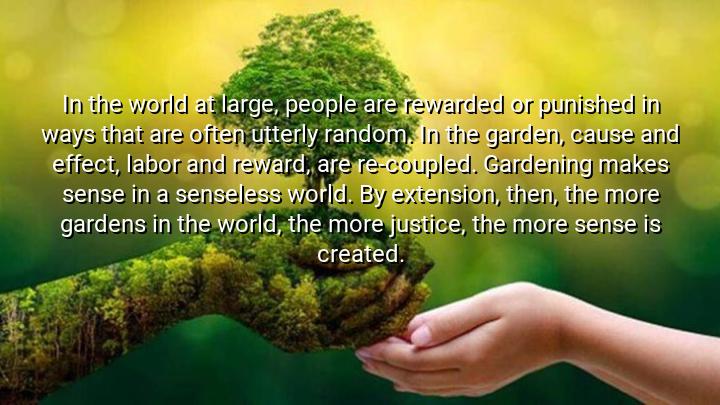




The quote "In the world at large, people are rewarded or punished in ways that are often utterly random. In the garden, cause and effect, labor and reward, are re-coupled. Gardening makes sense in a senseless world. By extension, then, the more gardens in the world, the more justice, the more sense is created" by Andrew Weil explores the idea that in life, rewards and punishments can often feel arbitrary and disconnected from effort or deserving outcomes. However, gardening offers a direct relationship between cause and effect, where the effort of planting and tending results in growth and reward, creating a sense of order and purpose. In this sense, Weil suggests that the principles of gardening provide a structured framework in an otherwise unpredictable and chaotic world.
Weil’s comparison of the world to a garden highlights how gardening reflects a system of justice and balance. Unlike the randomness of life's outcomes, where good things do not always happen to good people, gardening provides a clear link between hard work and its results. The process of nurturing plants rewards the gardener with tangible, visible outcomes, which reinforces the idea of a just system where effort is directly tied to results. This, for Weil, offers a sense of relief from the frustrations of the chaotic and unfair nature of the broader world.
The statement "the more gardens in the world, the more justice, the more sense is created" expands this metaphor, suggesting that if more people engaged in gardening, the world might become a more just, orderly place. Through gardens, people can experience balance, equity, and a sense of control over their environment. Gardening symbolizes a restorative act that can provide a refuge from the chaos of life and help to create a more harmonious world, where actions are tied to consequences in a clear and meaningful way.
Andrew Weil, a doctor and author known for his focus on integrative medicine and well-being, often discusses the connection between health and natural practices. His words on gardening reflect a broader belief in the healing power of nature and how engaging with it can provide not just physical benefits but also emotional and spiritual restoration. Through gardening, Weil suggests that people can reclaim a sense of order and justice in a world that often feels uncertain and random.

AAdministratorAdministrator
Welcome, honored guests. Please leave a comment, we will respond soon