

In the different voice of women lies the truth of an ethic of care, the tie between relationship and responsibility, and the origins of aggression in the failure of connection.
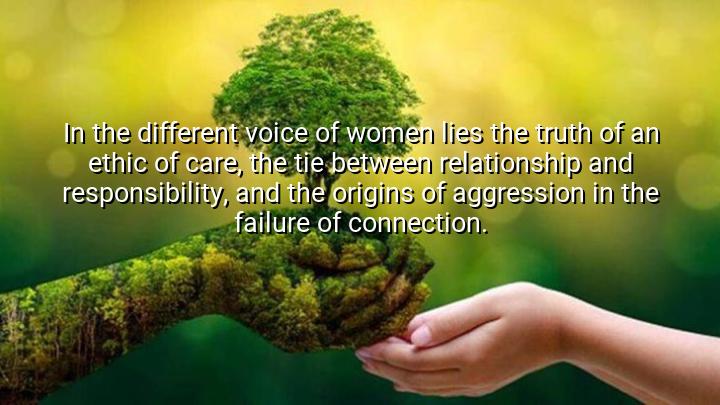




Carol Gilligan’s quote explores the idea that the voice of women reveals a distinct ethical perspective rooted in care, connection, and responsibility. Gilligan, a prominent psychologist, argues that women often prioritize relationships and care in their moral reasoning, contrasting with more traditional, rule-based approaches to ethics. The ethic of care she describes emphasizes the importance of empathy, nurturing, and maintaining connections with others, particularly in the context of personal relationships.
The quote also delves into the idea that aggression can arise from the failure of connection. Gilligan suggests that when relationships are broken or neglected, aggression may surface as a response to the emotional and psychological distance created by that disconnection. In her work, she contends that human behavior—especially aggression—is often rooted in the inability to maintain meaningful, compassionate connections with others. This insight challenges traditional views that aggression is simply a result of individual flaws or external circumstances.
As a feminist psychologist, Gilligan’s work has focused on how gender influences moral development. Her influential book, In a Different Voice, introduced the idea that women approach moral dilemmas differently than men, often through the lens of care and relational ethics. By exploring the different voice of women, Gilligan sought to reveal the ways in which gender shapes moral reasoning, particularly in how women navigate the responsibilities and duties inherent in relationships.
Ultimately, Gilligan’s quote underscores her belief that an ethic of care is central to understanding human morality and behavior. It encourages a shift away from aggressive or competitive models of success toward a more interconnected, compassionate approach to life. This ethic not only promotes understanding the roots of aggression but also highlights the importance of connection in fostering a healthier, more empathetic society.

AAdministratorAdministrator
Welcome, honored guests. Please leave a comment, we will respond soon