

In the age of globalisation, pooled sovereignty means more power, not less.
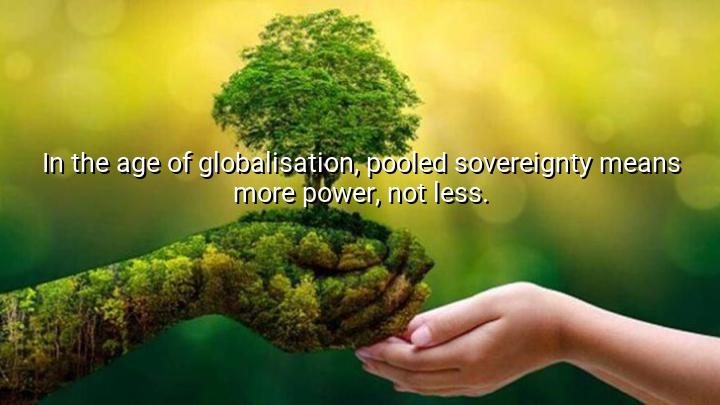




Jose Manuel Barroso’s quote, "In the age of globalisation, pooled sovereignty means more power, not less," reflects his view on the evolving relationship between nation-states and international institutions in the modern world. Barroso is suggesting that, contrary to the belief that globalisation might weaken national sovereignty, the sharing or pooling of sovereignty through international cooperation can actually enhance a nation’s ability to exert influence and power on the global stage. In this context, pooled sovereignty refers to countries working together within global or regional frameworks, like the European Union, to address challenges that transcend borders, such as economic crises, climate change, and security issues.
The quote emphasizes that as the world becomes more interconnected, no single nation can effectively address global problems alone. By pooling sovereignty, countries can leverage collective resources and capabilities to tackle issues more effectively than they could independently. This collaboration increases their power in global governance, as it allows them to influence international decisions, negotiate better trade agreements, and address common challenges with greater coordination.
Jose Manuel Barroso, the former President of the European Commission, played a significant role in European integration during his tenure. His quote is rooted in his experiences with the European Union and his advocacy for greater political and economic integration across Europe. As a leader of a supranational body, Barroso believed that working together as a collective would strengthen the influence of member states in the global arena, rather than diminishing it.
In essence, Barroso’s quote highlights the paradox that, in an era of increasing globalisation, the sharing of power through international agreements can lead to a more effective and powerful political position. The pooling of sovereignty allows nations to navigate complex global dynamics and challenges more efficiently, ultimately enhancing their collective strength in a rapidly changing world.

MVMai Vu
Reading this quote makes me think about the paradox of control. Is giving up some national decision-making really a loss, or could it lead to greater influence in a global context? It's similar to teamwork—no one controls everything, but together you can accomplish more. Still, I wonder how much public understanding and support exists for this concept. Do people generally see pooled sovereignty as empowerment, or as a threat to national independence?
Mmoinang
I find this idea both provocative and hopeful. In a world where unilateral action often leads to conflict or inefficiency, the idea that nations can gain power by cooperating is refreshing. But how do we maintain accountability in such arrangements? Who decides the terms, and how are disputes handled fairly? Without robust legal and institutional frameworks, could pooled sovereignty devolve into bureaucratic dominance by a few key players?
LMLuan Minh
Honestly, this quote makes me skeptical. On paper, shared sovereignty sounds efficient and empowering, but in reality, who really benefits from it? Often, it feels like the bigger powers dominate decision-making while smaller nations are expected to fall in line. Is this truly a power gain for all, or just a diplomatic way of masking inequality? I'd love to see more concrete examples where pooled sovereignty led to tangible, equal gains.
PHMan Phan Hue
This quote raises an important question: what kind of power are we talking about? Is it military, economic, diplomatic, or something else? I’m curious whether pooled sovereignty empowers governments or the people they represent. Do citizens feel more powerful when their country joins alliances, or does it create a sense of distance between them and decision-makers? This is especially relevant in debates about supranational entities like the EU or UN.
UNNgo Uyen Nhi
As someone who supports international collaboration, I find this quote intriguing. It challenges the common fear that global institutions weaken individual nations. But does this idea work equally well in practice? In the EU, for example, shared sovereignty has brought economic and political clout, but also internal tensions. What mechanisms need to be in place to balance collective power with democratic accountability and cultural autonomy?