

In search of my mother's garden, I found my own.
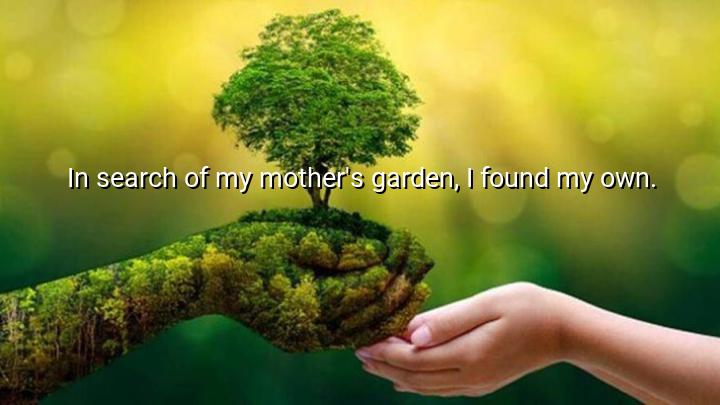




The quote by Alice Walker, "In search of my mother's garden, I found my own," speaks to the theme of personal growth and self-discovery. Walker reflects on the journey of exploring her heritage, influenced by her mother, and how that search led her to uncover her own identity and creative path. The "garden" in this context can be seen as a metaphor for creativity, nurturing, and self-expression, something that both her mother and she possess but in different forms. By seeking her mother's garden, Walker finds a way to cultivate her own, one that is uniquely her own while still rooted in her mother’s influence.
Walker’s statement suggests that understanding and honoring the past—represented by her mother—can serve as a foundation for personal evolution. The idea of a garden as a space for growth and nurturing highlights the importance of connecting with one's roots, but also pushing beyond them to create something new. Through her mother's legacy, Walker finds not just a reflection of her mother’s experiences, but an opportunity to develop her own voice and path in the world.
The quote also touches on the theme of intergenerational influence. It reflects how the values, teachings, and traditions passed down by one generation—especially the maternal influence—can guide the next generation toward discovering their own sense of purpose. In Walker’s case, the search for her mother’s garden is also a process of understanding her heritage and, ultimately, finding her own place within it. It speaks to the idea of inheritance and the realization that each person can build upon the foundation laid by their predecessors, while still cultivating their unique expression.
The origin of this quote is tied to Alice Walker’s own experiences as an author and activist. Known for her works that explore the African American experience, particularly in her acclaimed novel The Color Purple, Walker often writes about the strength and resilience of women, especially mothers. This quote comes from her collection of essays and reflects her belief in the transformative power of heritage, creativity, and the ways in which we can both honor and build upon the legacies of those who came before us.

AAdministratorAdministrator
Welcome, honored guests. Please leave a comment, we will respond soon