

In every age 'the good old days' were a myth. No one ever thought they were good at the time. For every age has consisted of crises that seemed intolerable to the people who lived through them.
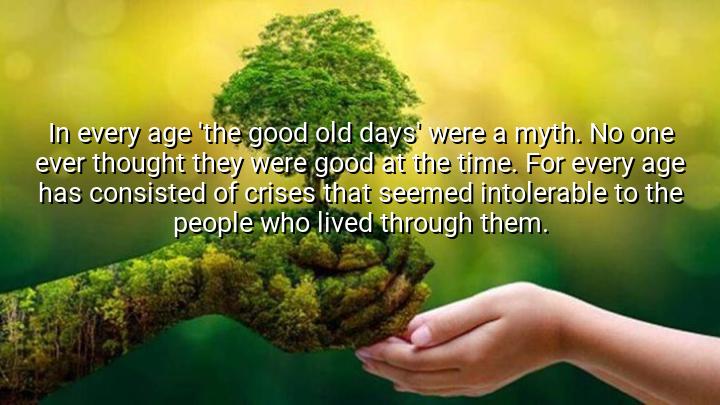




In this quote, Brooks Atkinson reflects on the myth of nostalgia for the past, specifically the idea of the "good old days." He argues that no generation ever truly believed they were living in a golden age during their time; instead, every era has been marked by crises and challenges that seemed intolerable to the people living through them. Atkinson suggests that the idea of a perfect past is a myth, created by looking back at history with a sense of romanticism or selective memory.
Atkinson's statement challenges the common tendency to idealize the past and lament the present. He points out that every age, no matter how far back, has been fraught with difficulties that felt overwhelming at the time. Whether it was economic hardship, political instability, or social upheaval, the people living through those periods likely saw them as crises that were impossible to overcome. This realization calls into question the validity of nostalgia, suggesting that each era's perceived difficulties are a natural part of the human experience.
The quote also speaks to the idea that history is often remembered through a distorted lens, with the present feeling worse than the past simply because of the passage of time. Atkinson’s words suggest that, while challenges may seem unbearable at the moment, they are often seen differently in hindsight, with the passage of time softening their impact. This perspective encourages a more balanced view of history, where each era is recognized for its unique struggles, rather than idealized as a time of perfection.
Ultimately, Brooks Atkinson emphasizes that crises and difficulties are a constant part of the human experience, and every generation faces its own challenges that shape its view of the world. His quote invites us to reconsider our longing for the past and to acknowledge that, in reality, each age has had its own share of hardships. This recognition can help us better appreciate the present and the ways in which we navigate our own challenges.

TMNguyen Tra My
Such an insightful observation! It makes me think about how easily history gets rewritten in everyday conversation. People talk about their youth or certain decades like they were utopias, but if you dig into the details, those periods were just as fraught with anxiety and unrest. Do we romanticize the past simply because we survived it? Or is it that the hardships fade in memory, leaving behind only what we choose to glorify?
UPUyen Phuong
This quote speaks volumes about our cultural obsession with nostalgia. We often act like we're living in decline compared to some imagined golden age, but Atkinson reminds us that every era was riddled with its own fears and problems. I wonder if this mindset prevents us from appreciating current opportunities. Why do people need to believe the past was better? Is it fear of the unknown, or resistance to the complexity of change?
R_Rabbit _Gaming
I think Atkinson hits on a kind of collective amnesia we all suffer from. It’s so easy to remember only the good parts of the past and ignore the hardships. But why do we do this? Is it just selective memory, or is there something psychological at play? This quote makes me want to question the narratives I’ve inherited about 'better times' and look more critically at how we build stories around history.
NQThanh Nguyen Quang
What I find fascinating about this quote is how it challenges the comforting illusion that the past was somehow easier or more peaceful. Is it human nature to romanticize what we’ve survived? Maybe it helps people feel a sense of stability or continuity. But I wonder—does this myth keep us from facing the present with courage? If we keep insisting the past was better, do we lose the drive to improve today?
NHnguyen hong
This feels incredibly timely. We keep hearing phrases like 'back when things were simpler' or 'those were the days,' but were they really? Atkinson's point makes me think that maybe every generation feels overwhelmed in their moment. Is this why we fail to learn from history? Because we forget how hard it actually was? I’d love to explore how this myth of the 'good old days' affects political and social attitudes today.