

In all my life, I have never been free. I have never been able to do anything with freedom, except in the field of my writing.
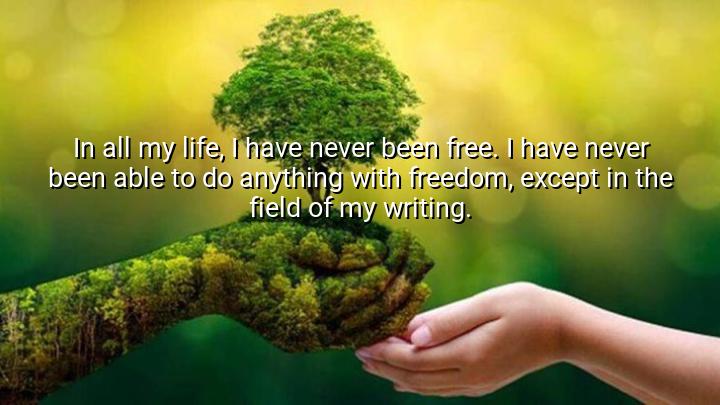




Langston Hughes' quote, "In all my life, I have never been free. I have never been able to do anything with freedom, except in the field of my writing," reflects his personal struggle with oppression and the limited freedoms he experienced throughout his life. Hughes, as an African American poet during a time of racial segregation and injustice, was often constrained by the societal and racial restrictions imposed upon him. The use of the word freedom underscores the tension between his desires and the reality of his existence, where true freedom was often out of his reach.
Hughes emphasizes that, despite his longing for freedom, the only area where he felt truly liberated was in his writing. Writing, for Hughes, became a form of self-expression and a space where he could explore ideas, speak his truth, and challenge societal norms without restriction. In his poetry, he found a voice that allowed him to express his thoughts and emotions freely, something that was denied to him in other aspects of his life due to the racial and societal barriers he faced.
This quote also speaks to the broader theme of creative freedom in the face of oppression. Hughes’ ability to write freely and express his ideas through his work was, in many ways, a form of resistance. In a society that sought to silence him and others like him, his writing became not just an outlet for personal expression, but also a tool for social change, enabling him to address issues like racial inequality, identity, and the African American experience.
In essence, Hughes’ words highlight the paradox of his life—a life marked by limitations on his personal freedoms, but one where his writing offered him a unique opportunity to experience a profound sense of liberation. His quote underscores the power of creative expression as a means of asserting one’s identity and challenging the constraints imposed by society.

AAdministratorAdministrator
Welcome, honored guests. Please leave a comment, we will respond soon