

In age of consumerism and materialism, I traffic in blue sky and colored air.
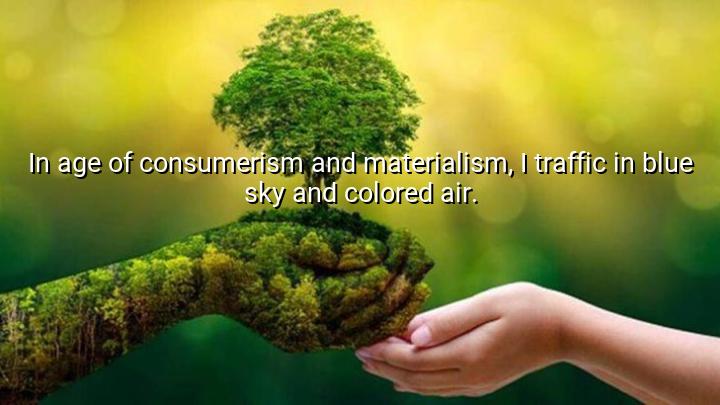




The quote "In an age of consumerism and materialism, I traffic in blue sky and colored air" by James Turrell, an American artist renowned for his works focused on light and space, highlights his departure from the materialism that dominates contemporary society. Turrell contrasts his work with the prevailing cultural obsession with consumption and tangible goods, instead choosing to focus on the intangible and the ethereal—such as light, sky, and atmosphere. By stating that he “traffics in blue sky and colored air,” Turrell metaphorically suggests that he deals in things that are not physical or commodifiable, offering an alternative to the materialistic values that often dominate modern life.
Turrell's statement also reflects his belief in the spiritual and transformative power of art that transcends the ordinary physical world. His works often create immersive experiences that allow people to perceive light and space in a way that alters their awareness of their surroundings. By working with elements like light and the sky, he invites his audience to experience something beyond the material, reconnecting with nature and a sense of wonder that is often overlooked in the rush of consumer culture.
The phrase “blue sky and colored air” serves as a poetic image of freedom, open spaces, and unbounded potential. These elements cannot be bought, sold, or owned in the traditional sense, making them a stark contrast to the commodification of everyday life in a consumer-driven society. Through this metaphor, Turrell elevates his artistic practice as a way to engage with the intangible, offering a space for reflection and contemplation away from the pressures of materialism.
Ultimately, Turrell’s quote advocates for the value of art and experience that focus on the aesthetic and spiritual rather than the monetary. By choosing to "traffic" in something as ephemeral as light and air, he challenges the conventional metrics of success and encourages a deeper connection with the immaterial beauty of the world, offering a refuge from the relentless pursuit of material wealth.

QCTang Quoc Cuong
There’s something almost meditative about this statement. I picture someone working with the raw elements of nature, asking us to slow down and really see the world. But is this idealistic? Can this philosophy reach people living in hyper-urban environments or facing economic instability? I’d love to hear how Turrell himself reconciles this artistic philosophy with the demands of modern life.
QDquyen dang
This quote got me thinking about the role of art in our current era. Turrell seems to place emphasis on light, perception, and space—things we often overlook because they can’t be bought or sold. How might our priorities shift if more people embraced this way of thinking? Would it fundamentally change how we educate, create, and even define success in our lives?
BLNguyen Minh bao Linh
I really admire the subtle defiance in this quote. It’s as if Turrell is reminding us of the value in simplicity, in observing rather than consuming. But it does raise a question: is it possible to thrive as an artist or thinker who doesn’t cater to market demands in today’s world? Can someone truly reject consumerism and still find sustainability and visibility in their work?
NKNguyen Khanh
Turrell’s words resonate deeply with me, especially because I often feel overwhelmed by the constant pressure to buy, own, and upgrade. It’s refreshing to hear from someone who finds value in intangible beauty. But I also wonder—can the average person afford to detach from materialism when basic needs are tied to economic systems? Is there a way to reconcile art and nature with daily survival in a consumer-driven society?
Ssuewfegregr
I find this quote from James Turrell incredibly poetic and grounding. In a world obsessed with possessions and profit, the idea of ‘trafficking in blue sky and colored air’ feels almost rebellious. It makes me wonder—can art truly serve as a form of resistance to consumer culture? And if so, is it enough to just witness it, or should we also try to live by these values ourselves in some tangible way?