

I'm trying to create architecture as landscape. But I'm not copying nature.
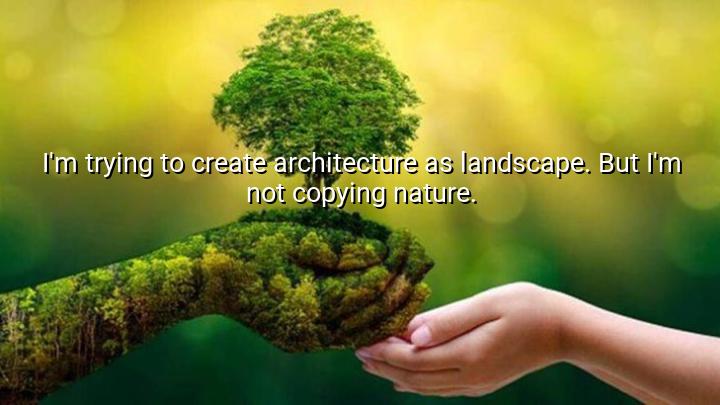




Ma Yansong’s quote, “I’m trying to create architecture as landscape. But I’m not copying nature,” encapsulates his unique vision of blending architecture and natural form in a harmonious, yet non-literal way. He aims to design buildings that evoke the feelings and spatial dynamics of the natural world—such as flow, movement, and organic form—without directly replicating natural features like mountains or rivers. His goal is to develop architecture that behaves like a landscape, shaping emotional and environmental experiences rather than mimicking nature’s exact appearance.
The distinction he makes between creating as landscape and copying nature is key to understanding his design philosophy. For Ma, nature is not a pattern book to imitate but a source of inspiration for how buildings can connect people to their surroundings, evoke tranquility, and promote ecological balance. His approach results in structures that feel fluid and sculptural, drawing from the essence of nature rather than its surface details. This philosophy is evident in his projects like the Harbin Opera House and Chaoyang Park Plaza, where buildings rise like hills or clouds, integrating with their sites in an almost poetic manner.
By avoiding literal representations of natural forms, Ma encourages a more creative and interpretive relationship with the environment. His architecture doesn’t just sit on the land—it becomes part of the land’s spiritual and visual rhythm, forming a dialogue between the built and natural worlds. This method fosters spaces that invite reflection, wonder, and a sense of belonging, while remaining firmly rooted in the technological and cultural realities of contemporary urban life.
This quote originates from Ma Yansong’s many public talks and interviews where he explains his concept of the "shan-shui city"—a model that merges urban density with landscape-inspired forms. As the founder of MAD Architects, Ma has pioneered a distinctly Chinese yet globally resonant approach to architecture that seeks to redefine the human relationship with nature, not by duplicating it, but by reinterpreting its spirit in built form.

AAdministratorAdministrator
Welcome, honored guests. Please leave a comment, we will respond soon