

I'm not a luddite. Science, computers, medicine, they're all great. But nature is context. That which we can't control. Its constant mortality and immortality is an answer to the terror of finite existence. It reassures the soul.
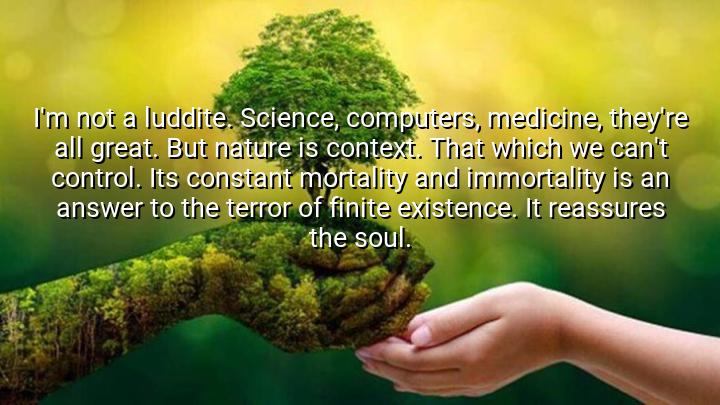




In this quote, Victoria Coren Mitchell presents a balanced perspective on the relationship between technology and nature. She begins by clarifying that she is not a luddite, or someone opposed to technological progress. She acknowledges that science, computers, and medicine are valuable advancements that have greatly benefited society. However, she emphasizes that nature provides something essential that technology cannot replicate: context.
Mitchell suggests that nature represents that which is beyond human control, and it serves as a reminder of mortality and immortality. The ever-changing cycles of life, death, and renewal in nature act as an antidote to the human fear of finite existence. While technology offers solutions and comfort in a world of uncertainty, nature, in its uncontrollable and persistent patterns, provides a kind of reassurance that our lives are part of something much larger and eternal.
The reference to nature also touches on the idea of existential comfort. Mitchell believes that nature’s ability to embody both life and death helps to alleviate the terror associated with the limited nature of human existence. This duality of mortality and immortality in nature offers a form of peace, as it reminds us that life, in all its complexity, continues regardless of human effort or intervention.
Ultimately, Mitchell’s quote encourages a deeper appreciation for nature as something that transcends human influence, offering solace and perspective in a world increasingly shaped by technology. It suggests that while technological progress is vital, there is something profoundly comforting in the eternal rhythms of nature that remind us of our place in the vastness of existence.

AAdministratorAdministrator
Welcome, honored guests. Please leave a comment, we will respond soon