

The key to nature's therapy is feeling like a tiny part of it, not a master over it. There's amazing pride in seeing a bee land on a flower you planted - but that's not your act of creation, it's your act of joining in.
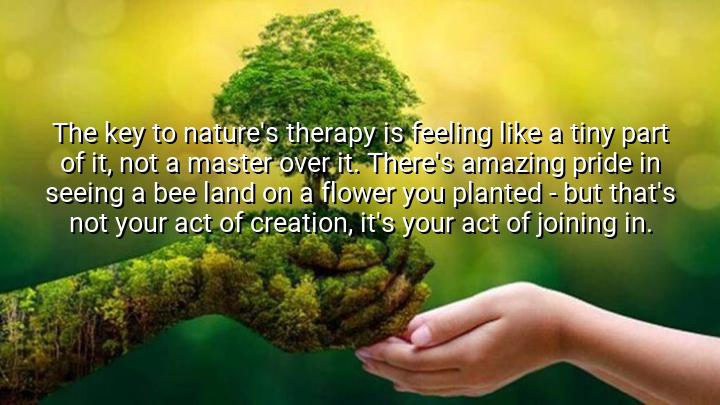




In this quote, Victoria Coren Mitchell explores the idea of harmony with nature rather than domination over it. She suggests that the true essence of nature's therapy comes from recognizing ourselves as a small part of a much larger ecosystem, rather than attempting to control or conquer it. This perspective encourages a humble appreciation for nature's beauty and complexity, emphasizing the importance of connection rather than superiority.
The phrase, "there’s amazing pride in seeing a bee land on a flower you planted," captures a moment of fulfillment, yet it reframes pride as something shared between the person and the natural world. The bee and the flower are part of a broader cycle that exists independently, and the joy comes not from creation, but from joining in the natural process. Mitchell suggests that we should appreciate nature’s wonders without taking full credit for them.
Mitchell contrasts "your act of creation" with the more humble role of participating in the natural world. By using the term "joining in," she invites us to see ourselves as collaborators rather than creators. This implies that nature is not something to control, but something to respect and become a part of. It's about fostering a sense of belonging rather than ownership.
Ultimately, the quote advocates for a mindset shift toward coexistence with nature. It calls for a deeper appreciation of the interconnectedness between humans and the environment, focusing on the joy that comes from being a small part of something larger than ourselves. Mitchell’s words highlight the beauty in humility and the peace found in simply participating in the natural world.

MTtran minh tuong
There’s something poetic about the idea of not owning nature, but rather participating in its rhythm. Yet, I’m curious how this concept fits with the modern push for sustainability. Is adopting a mindset of humility and interdependence enough to reverse environmental damage? Or do we need more than just emotional connection — like systemic change? It’s a lovely quote, but I wonder if it risks romanticizing a problem that’s deeply structural.
Hhaiyen
The image of a bee landing on a flower you planted really touched me. But it made me ask myself — do we need this kind of direct interaction to feel connected to nature, or can appreciation alone suffice? Is feeling 'a tiny part of it' something internal, or does it require active involvement like growing food or hiking? I’d be interested to know what practices help others feel this sense of belonging.
TTTran Thi Trang
This quote is beautiful, but I can’t help but feel a little conflicted. Isn’t there a thin line between participating in nature and unintentionally harming it? For example, even planting non-native species could disrupt ecosystems. So how do we truly 'join in' responsibly? I’m curious how others interpret this in practical, ecological terms—especially gardeners or conservationists. Where does appreciation end and interference begin?
VTVan Tran
I love the gentle humility in this quote. It makes me wonder — do you think our growing disconnect from nature is partly because we try too hard to control it? With urbanization and technology dominating our lives, is it possible to genuinely 'join in' with nature anymore? Or is this feeling something we have to consciously seek out, like through gardening or wilderness retreats?
BMDien Chem chet me bon may
This quote really struck a chord with me. It made me think — in a world so obsessed with control and ownership, can we truly learn to see ourselves as participants rather than dominators in nature? What kind of mindset shift does it take to stop seeing natural spaces as things to be tamed or improved, and instead see them as systems we’re lucky to be part of? I’d love to hear others’ thoughts on this.