

I'm always told that what I say is controversial. Why is it controversial? Because I speak from a tradition that has now fallen out of favor with the dominant media in this country. And so when I say things like marriage should be between one man and one woman, I'm called a bigot.
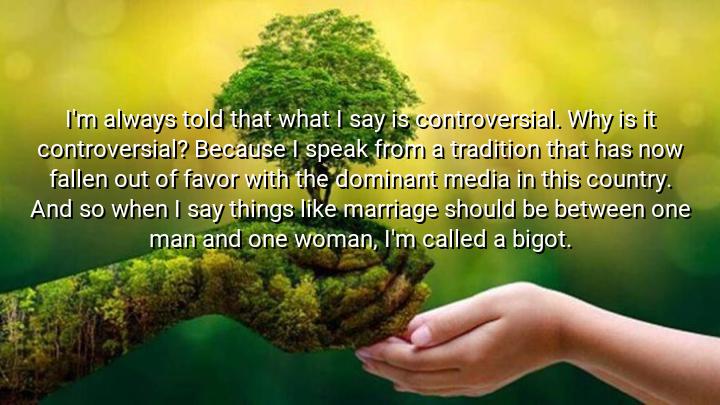




The quote by Rick Santorum reflects his perspective on controversy and the shifting cultural values in contemporary society. He begins by noting that his statements are often labeled as controversial, implying that public reaction is more about societal trends than the intrinsic nature of his views. According to him, his perspective is rooted in a tradition that once held widespread acceptance but has increasingly diverged from the norms promoted by the dominant media in the United States. This framing sets the stage for understanding the tension between personal belief and public perception.
Santorum specifically mentions his stance on marriage, asserting that it should be defined as between one man and one woman. For him, this view is not an arbitrary opinion but stems from a long-standing cultural and religious tradition. However, as societal attitudes evolve, particularly around LGBTQ+ rights and same-sex marriage, such a position has become increasingly contentious. In his view, labeling this belief as bigotry reflects a disconnect between contemporary media narratives and older societal norms.
The origin of this quote lies in Santorum's political career, particularly as a social conservative advocating for traditional family values. He has frequently positioned himself as a defender of Christian moral principles in the public sphere, often framing opposition to his views as a cultural bias promoted by mainstream media outlets. The quote illustrates his perception of being marginalized for adhering to beliefs that were once widely accepted, highlighting the broader societal shift in how traditional values are debated and perceived.
Overall, the quote captures the clash between conservative ideology and the modern media landscape, reflecting both personal conviction and the broader cultural debate over morality, tradition, and social change. Santorum emphasizes that the controversy surrounding his statements is not accidental but a result of speaking from a perspective increasingly at odds with prevailing societal norms, inviting reflection on how media framing shapes public discourse.
If you want, I can also make an even more concise 2-paragraph version that hits just the essential meaning and origin.

AAdministratorAdministrator
Welcome, honored guests. Please leave a comment, we will respond soon