

If you hit a Talib with your shoe, then there would be no difference between you and the Talib. You must not treat others with cruelty and that much harshly, you must fight others but through peace and through dialogue and through education.
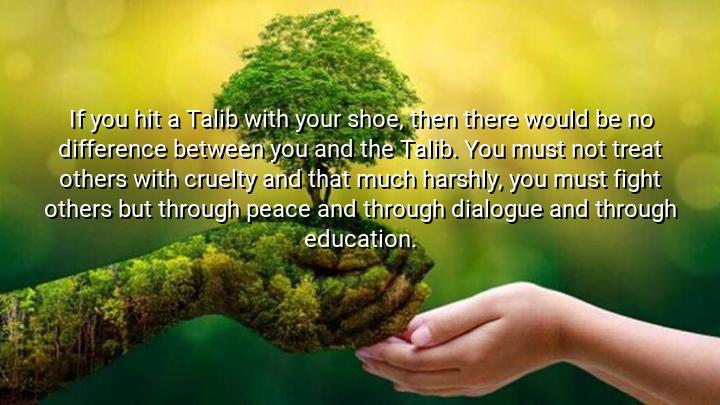




The quote by Malala Yousafzai emphasizes the importance of responding to conflict with peace, dialogue, and education rather than violence. She explains that harming others, even in retaliation—such as hitting a Talib with a shoe—makes one morally indistinguishable from the aggressor. Malala stresses that true strength lies in addressing injustice and oppression through nonviolent means rather than cruelty.
Central to this perspective is the belief in the transformative power of education. Malala advocates for learning and conversation as tools to overcome hatred and ignorance. By promoting peaceful engagement, society can resolve conflicts while fostering understanding and empathy, which ultimately leads to more lasting and meaningful change than violence ever could.
The origin of this quote comes from Malala Yousafzai, a Pakistani education activist and Nobel Peace Prize laureate. Having survived an attack by the Taliban for advocating girls’ education, Malala embodies the principle that education and dialogue are more powerful than weapons. Her experiences highlight the need for courage, moral clarity, and commitment to nonviolence in the face of oppression.
In essence, Malala’s quote underscores that education and peaceful action are the most effective responses to conflict. By rejecting cruelty and embracing dialogue, individuals can uphold their principles, protect human dignity, and work toward a just and compassionate society.

AAdministratorAdministrator
Welcome, honored guests. Please leave a comment, we will respond soon