

If happiness truly consisted in physical ease and freedom from care, then the happiest individual would not be either a man or a woman; it would be, I think, an American cow.
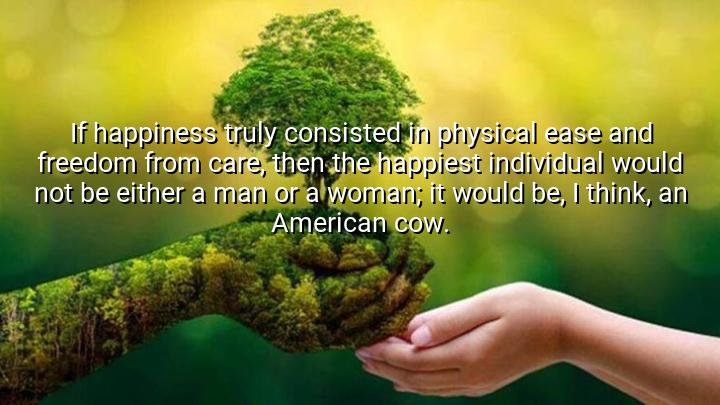




In this quote, William Lyon Phelps humorously explores the idea of happiness by suggesting that if it were solely defined by physical ease and the absence of care, then the happiest being would not be a human but rather an American cow. Phelps uses the example of a cow, typically seen as living a life of ease, to highlight how material comfort alone is not a sufficient definition of true happiness. His point is that happiness is not simply about comfort or a carefree existence.
Phelps’ comment challenges the notion that external comforts, such as a lack of responsibility or hardship, lead to true happiness. Instead, he implies that human happiness is more complex and involves factors beyond just physical comfort. While the cow may live a life without much struggle, it lacks the deeper aspects of happiness, such as purpose, meaning, and emotional fulfillment, which humans seek in their lives.
The mention of the American cow also carries a bit of social commentary, subtly poking fun at the luxury and excess often associated with certain aspects of modern American life. It serves as a metaphor for how some might pursue comfort and ease without considering that these factors alone do not lead to lasting or fulfilling happiness. Phelps is making a broader point about the importance of looking beyond superficial conditions.
William Lyon Phelps was an American academic, author, and critic, known for his reflections on literature, human nature, and society. This quote encapsulates his thoughtful and often witty approach to exploring complex ideas, particularly the nature of happiness and its deeper roots beyond mere physical comfort. Through humor, Phelps invites us to reflect on what truly makes life meaningful and fulfilling.

AAdministratorAdministrator
Welcome, honored guests. Please leave a comment, we will respond soon