

If dinner needs to be served to the father, if clothes need to be ironed, parents ask the girl to do it, not the boy. Why? Equality needs to begin at home.
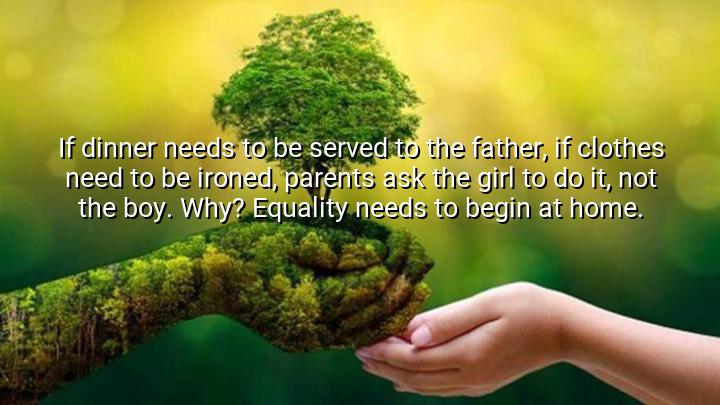




The quote by Mahima Chaudhry draws attention to the everyday gender roles and domestic expectations that are often imposed on girls within households. She highlights how tasks like serving dinner or ironing clothes are disproportionately assigned to daughters rather than sons, reflecting the persistence of traditional stereotypes. The meaning behind her words is clear: if society is to achieve genuine equality, it must start by challenging these small but deeply ingrained biases at home.
The origin of this quote lies in Mahima Chaudhry’s public discussions about gender equality and her advocacy for breaking stereotypes in Indian society. As a former actress who has spoken about social issues beyond cinema, she points out how inequality often begins in the most fundamental unit of society — the family. By addressing this, she emphasizes that schools, workplaces, or governments cannot fully fix gender disparities if children are raised in environments where unequal roles are normalized.
Her statement also sheds light on the subtle yet powerful ways in which children internalize gender norms. When girls are consistently expected to take on domestic duties while boys are excused, they grow up with an ingrained belief that such roles are “natural.” Chaudhry’s call for equality at home underscores the importance of re-educating families to distribute responsibilities fairly, ensuring that boys and girls alike understand the value of shared work.
Ultimately, this quote emphasizes that social change begins in private spaces. For equality to thrive in public life — whether in workplaces, politics, or leadership — it must first be practiced in households. By questioning and changing these daily habits, Chaudhry suggests, families can raise a generation that genuinely believes in and practices gender equality.

AAdministratorAdministrator
Welcome, honored guests. Please leave a comment, we will respond soon