

I wanted to be a forest ranger or a coal man. At a very early age, I knew I didn't want to do what my dad did, which was work in an office.
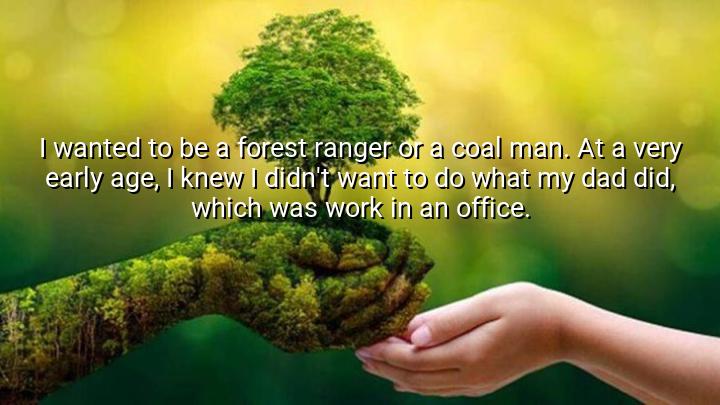




In this quote, Harrison Ford, the legendary American actor, reflects on his early aspirations and his desire to avoid a traditional, desk-bound job. He mentions that at a very early age, he knew he didn't want to follow in his father's footsteps, who worked in an office. Ford expresses a preference for more active and outdoor careers, such as becoming a forest ranger or a coal man, indicating that he was drawn to jobs that were hands-on and connected to nature, rather than the conventional office environment.
Ford's statement reveals his early inclination toward independence and an adventurous spirit. While many children might simply follow the example set by their parents, Ford had a strong sense of his own preferences, rejecting the idea of a conventional office job in favor of something more physical and free-spirited. This mindset would later translate into his choice of roles as an actor, where he often portrayed characters who embodied similar qualities of adventure and exploration, such as Indiana Jones and Han Solo.
The origin of this quote likely stems from Ford’s formative years, growing up in a family where traditional career paths were valued. Despite this, Ford gravitated toward a non-conventional lifestyle and career, which would eventually lead him to pursue acting, where he found his true calling. His early resistance to a life spent in an office environment is emblematic of his later career, where he sought out roles that allowed him to explore new worlds and embrace the adventure and freedom he longed for as a young person.
Ultimately, Ford’s words underscore the importance of individuality and self-awareness in choosing a career. His early desire to avoid working in an office reflects a broader theme in his life and career: a pursuit of freedom, adventure, and roles that allowed him to step outside the traditional expectations set by society. This quote highlights the significance of following one's instincts and pursuing a path that aligns with personal values and interests.

TDDo Thuy Duong
I find this really refreshing—most kids want to be astronauts or superheroes, but Ford was drawn to jobs that are deeply tied to nature and effort. It says a lot about his values early on. Maybe he associated office work with detachment and a lack of purpose. It’s funny that he ended up famous for roles that often emphasized hands-on, rogue-like independence. Maybe he did become his own kind of ranger after all.
CTDao Cam Tu
This quote opens up a broader conversation about how our childhood dreams reflect the environments we either crave or want to escape. Ford's aversion to office life at such a young age suggests a strong sensitivity to structure or confinement. Was it about rebellion, personality, or an early craving for freedom? It’s fascinating to consider how that instinct carried over into the bold, often stoic characters he became famous for.
DVPhu Dam Viet
I’m struck by the simplicity of the jobs Ford first imagined for himself. They weren’t glamorous—they were grounded, practical, maybe even gritty. It’s kind of poetic that he ended up in Hollywood, where roles often celebrate that exact kind of rugged individualism. Did he see acting as a compromise between physicality and creativity, or did he stumble into it while still trying to avoid that dreaded office life?
SPSon Pham
This quote resonates with me because I think so many people feel pressured to follow in their parents’ footsteps—even when it doesn’t suit them. Harrison Ford recognizing, as a kid, that his father's world wasn’t for him is really powerful. It’s a reminder that knowing what you don’t want can be just as important as knowing what you do. I wonder if his dad supported that choice or challenged it.
MDPham Minh Duc
There’s something really honest and earthy about wanting to be a forest ranger or coal man. It speaks to a desire for grounded, physical work—maybe even a rejection of the abstract nature of office life. I’d love to know what about the office bothered him so much. Was it the routine? The impersonality? It’s fascinating how that early clarity might have shaped his bold, unconventional path to acting.