

I think that two people who decide to live together in a marriage situation, they have an obligation to make the marriage work for them.
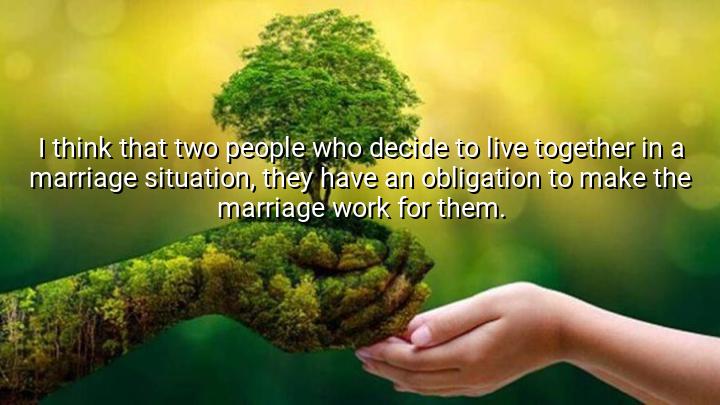




Helen Reddy’s statement, “I think that two people who decide to live together in a marriage situation, they have an obligation to make the marriage work for them,” highlights her practical view of marriage as a partnership rooted in responsibility and commitment. Rather than framing marriage in purely romantic or idealistic terms, she stresses the obligation of both partners to actively nurture the relationship and adapt it to their mutual needs.
By describing it as a “marriage situation,” Reddy emphasizes that the institution itself is less important than the shared decision of two people to build a life together. The key, in her view, lies in ensuring the arrangement “works for them,” suggesting flexibility and personal definition over rigid societal expectations. This reflects a progressive stance on relationships, where individual agency matters as much as tradition.
The origin of this quote can be traced to Reddy’s life as an Australian singer, actress, and feminist icon, best known for her anthem “I Am Woman.” Having lived through multiple marriages herself, Reddy spoke often about gender roles, independence, and the need for equality within personal relationships. Her words here capture a blend of personal experience and feminist perspective: marriage should not trap individuals but rather serve as a structure that both partners consciously maintain.
At its heart, the quote reflects Reddy’s broader philosophy—relationships require work, choice, and balance. Marriage is not simply guaranteed by vows or tradition; it succeeds only if both individuals invest in shaping it into something functional and fulfilling. In this way, her statement remains both pragmatic and empowering, reminding couples that lasting connection comes through shared effort.
Would you like me to also place this in the context of 1970s feminism, where Reddy’s views on marriage often clashed with more traditional narratives?

AAdministratorAdministrator
Welcome, honored guests. Please leave a comment, we will respond soon