

I remember, as a boy of 17 years of age, this was a fascinating thing for me: how we human beings breathe out carbon dioxide into the air, the leaves of plants pick this carbon dioxide up, and the plant gives off oxygen, which we can breathe in and keep our life going.
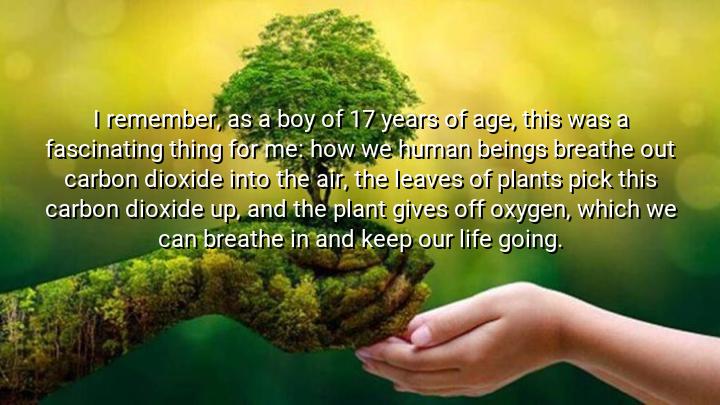




The quote, "I remember, as a boy of 17 years of age, this was a fascinating thing for me: how we human beings breathe out carbon dioxide into the air, the leaves of plants pick this carbon dioxide up, and the plant gives off oxygen, which we can breathe in and keep our life going," comes from Percy Julian, an American chemist and pioneer in the field of organic chemistry. In this statement, Julian recalls a moment of scientific curiosity from his youth, when he first learned about the biological process of photosynthesis and the relationship between humans and plants in terms of breathing and oxygen production.
Julian’s fascination with the exchange of gases between humans and plants reflects his early interest in the natural world. He describes how humans exhale carbon dioxide, a waste product of metabolism, which is then absorbed by plants through their leaves. This process allows plants to produce oxygen, a gas essential for human life, which humans then inhale to sustain themselves. Julian's excitement about this natural cycle underscores the interconnectedness of life on Earth and the vital role plants play in maintaining a balance between oxygen and carbon dioxide.
The quote also highlights the wonder Julian felt as a teenager when he first discovered the simplicity yet complexity of nature’s processes. His ability to marvel at this scientific phenomenon as a young person speaks to the curiosity and inquisitiveness that often drives scientific exploration. This moment of awe became a pivotal point in his intellectual development, likely inspiring his later work as a scientist.
Ultimately, Julian’s reflection serves as both a personal anecdote and a reminder of the elegance of nature’s systems. It emphasizes the importance of understanding the natural world and how fundamental processes like photosynthesis are crucial to maintaining life on Earth. His quote also exemplifies the lifelong impact of scientific curiosity and how early discoveries can shape an individual’s career and contributions to science.

MT26_Le Minh Thu
This recollection is a reminder of the intricate symbiosis between humans and plants, and it feels deeply humbling. But it also prompts me to ask: with climate change threatening plant life, how might this fundamental breathing cycle be impacted in the future? What innovations or policies are needed to protect this cycle that is so crucial to our survival?
Ddamtuankien
I love the way this quote reminds us of the unseen processes happening all around us. It makes me curious—how much do we really understand about the natural cycles that sustain life? Does modern society’s focus on artificial environments disconnect us from these essential realities? What role could community gardens or urban green spaces play in bridging this gap?
DHDat Ho
Percy Julian’s memory is a beautiful example of wonder sparked by simple truths. It also makes me think about how often we take such miracles for granted. How can educators and parents cultivate this sense of awe in children today, especially in an age dominated by technology and urban living? Could reconnecting with nature improve mental health as well as environmental awareness?
8LNgoc 8/7 Lan
This makes me reflect on the delicate balance that sustains life on Earth. But with increasing pollution and deforestation, I worry about how human activity might disrupt this natural cycle. What steps can society take to protect these vital ecosystems? How do we balance development with preserving the environment that keeps us alive?
GAnguyen tam gia an
I find it fascinating that such a basic biological process sparked curiosity in a young mind. It raises the question: how important is early education in science for inspiring future innovators? Do you think more hands-on experiences with nature during childhood could lead to greater interest in environmental science or sustainability efforts later in life?