

I only ask to be free. The butterflies are free.
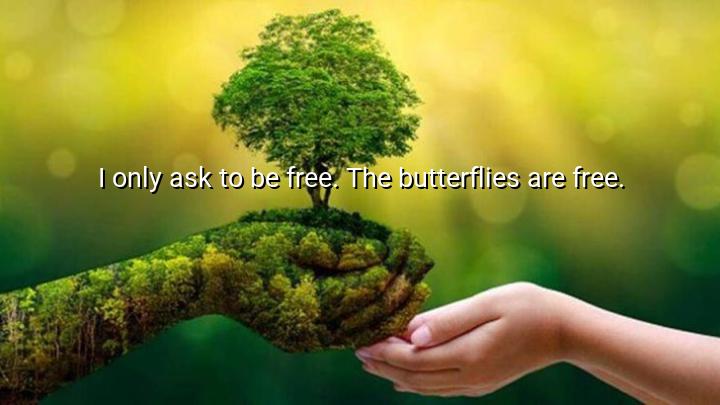




The quote "I only ask to be free. The butterflies are free" by Charles Dickens reflects a yearning for personal freedom and liberation from constraints. Dickens is expressing a desire for the same unburdened existence that butterflies have in nature. The butterfly, often seen as a symbol of transformation and freedom, represents the kind of unrestricted existence that the speaker longs for, free from societal, emotional, or physical limitations.
The comparison between human desires and the life of a butterfly underscores the idea that freedom is a natural state—one that is inherently beautiful and full of possibility. For the butterfly, life is spent without restraint, fluttering freely in the air, symbolizing the type of freedom that many people desire. In this context, Dickens contrasts the constraints imposed on people by society or circumstance with the effortless and unencumbered existence of the butterfly.
The origin of this quote can be understood in the broader context of Dickens' writings, where themes of personal liberty and social justice were often explored. While Dickens was known for his critiques of social inequality, this quote may be a metaphor for the kind of freedom he believed individuals should be able to experience, free from oppression and limitation. It speaks to a deeper philosophical notion that everyone should have the right to self-determination and autonomy, much like the natural freedom enjoyed by butterflies.
Ultimately, this quote by Charles Dickens calls for an ideal of freedom—one that is pure and uninhibited, like the life of a butterfly. It is a reminder that true freedom is an essential part of the human experience, and that we should strive for a world where people can live as freely and naturally as the butterfly.

AAdministratorAdministrator
Welcome, honored guests. Please leave a comment, we will respond soon