

I don't care about age very much. I think back to the old people I knew when I was growing up, and they always seemed larger than life.
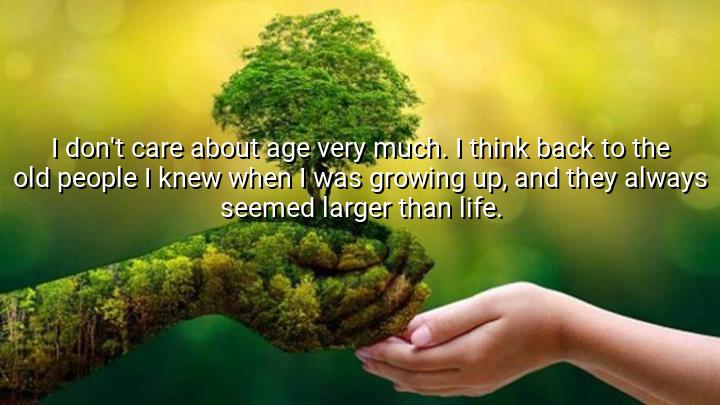




Chinua Achebe’s quote, "I don't care about age very much. I think back to the old people I knew when I was growing up, and they always seemed larger than life," reflects his perspective on how the elderly are often perceived with a sense of awe and respect, regardless of their physical age. Achebe emphasizes that age itself doesn’t hold much significance for him; instead, it's the wisdom, strength, and presence of the older generation that he values. For Achebe, the elderly are seen not for their years but for the enduring impression they leave on others, as figures of great influence and importance.
The quote highlights how Achebe’s perception of age was shaped by his early experiences with older people, who appeared to embody qualities that made them feel larger than life. Growing up, he was likely exposed to individuals whose experiences and stories gave them an air of greatness. The older generation, in Achebe’s view, wasn’t defined by their physical decline but by the deep knowledge and life experiences they carried, which made them seem monumental and respected by the younger generations.
Chinua Achebe, a celebrated Nigerian writer, is known for his novels that delve into African culture, history, and the impact of colonialism. In his works, such as Things Fall Apart, Achebe often explores themes of tradition, respect for elders, and the value of cultural continuity. His view on age and the elderly reflects this broader theme, where respect for elders is integral to understanding cultural heritage and the passing of wisdom across generations.
In essence, Achebe’s quote challenges common perceptions of age by emphasizing the larger-than-life qualities that older individuals can embody. Rather than focusing on physical age, he suggests that the real value of a person lies in the legacy they create and the wisdom they impart, which transcends the passage of time. The quote serves as a reminder to value and honor the elderly for the experiences and perspectives they bring, rather than just for their years.

LNBao Linh Nguyen
Achebe’s words remind me that age is subjective—it’s not just about numbers, but about how someone impacts us. I wonder if his experience growing up in a community where elders held significant cultural roles influenced his view. In today’s more individualistic societies, do older people still feel ‘larger than life’ to younger generations? Or has the power dynamic shifted toward youth, innovation, and speed over reflection and tradition?
BLthang bu lol
Reading this quote made me smile. I think there’s something powerful about the way childhood frames our understanding of adults—especially elders. They weren’t just old; they were wise, commanding, and sometimes even magical. Is that feeling still possible in a world that often chases youth and marginalizes aging? What does it take for someone today to seem ‘larger than life’ in the eyes of the next generation?
GDGold D.dragon
Achebe's reflection hits deep. It makes me wonder if part of the 'larger than life' impression we have of older people as children comes from the way we’re shaped by stories, tradition, and awe. As we grow, does that illusion fade, or do we simply stop seeing people through that lens of admiration? Maybe age isn’t as important as how we carry ourselves and what we choose to pass down.
DDDuong Dang
I love how Achebe downplays age in favor of lived experience and presence. It makes me question how much we really value age as a marker of worth. Are we too focused on numbers rather than depth of character? When I was young, older people often carried whole communities with their strength and quiet leadership. That kind of influence isn't tied to age—it's tied to spirit. Do we still nurture that today?
Aaqua
This quote evokes such nostalgia for me. I completely understand what Achebe is saying—growing up, the elders in my life had this aura of wisdom and mystery that made them feel almost mythical. I wonder if today’s youth still view older generations with that same reverence. Have we lost that sense of intergenerational respect and admiration in modern society? Or has the digital age just changed how we see influence and authority?