

I didn't cry much after I was 35, but staggered stony-faced into middle age, a handkerchief still in my bag just in case.
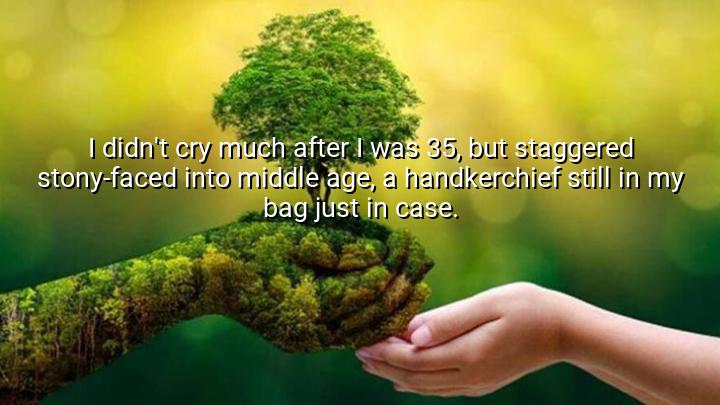




In this quote, Hilary Mantel, an English writer known for her historical novels, reflects on the emotional shift she experienced as she entered middle age. Mantel suggests that after the age of 35, she became less emotionally expressive, no longer crying as frequently. The phrase "staggered stony-faced into middle age" evokes an image of someone moving through life with a sense of stoicism and emotional restraint. Despite this, she humorously acknowledges that she still kept a handkerchief in her bag, ready for any emotional moment, implying that while she tried to suppress her feelings, she wasn't completely immune to them.
Mantel’s words convey a deeper reflection on the nature of aging and how emotional responses can change over time. As people grow older, they may become more accustomed to life's challenges, leading them to adopt a more composed demeanor. However, Mantel’s statement also hints at the vulnerability that remains, as she still carries the handkerchief as a safeguard for when emotions might surface unexpectedly. This contrast between emotional detachment and the lingering need for preparedness speaks to the complex relationship people have with their feelings as they age.
The origin of this quote lies in Mantel's introspective approach to life and aging. As an author, she often explores the intricacies of personal experience, particularly in the context of identity and change. Her reflection on middle age, and her use of humor to describe her emotional evolution, offers insight into how she views the passing of time—less as a decline in emotional sensitivity, but rather as a shift in how we handle and express emotions.
Ultimately, Mantel’s words offer a nuanced view of middle age—a time when emotional expression may become more subdued, but not entirely absent. Her acknowledgment of the handkerchief in her bag suggests that, despite the appearance of emotional control, the capacity for vulnerability and feeling remains, even as we age. The quote reminds us that while we may grow more resilient with time, the emotional complexities of life are always just beneath the surface, ready to be expressed when necessary.

HCHai Cu
The emotional restraint Mantel describes feels all too familiar. Why is it that as we age, we often lose the ability—or willingness—to express raw emotion? Is it social conditioning, or just emotional fatigue from decades of disappointment, change, and responsibility? The quote makes me wonder how many people walk around carrying unseen grief, armed with invisible handkerchiefs they never pull out.
THNguyen Thi Thu Hien
I’m intrigued by the tone—it's weary but also a little humorous. There’s strength in facing life head-on, even when you’re feeling hollow. But I wonder if there’s a cost to that kind of stoicism. Is it brave to ‘stagger stony-faced,’ or are we just afraid of what we’ll unleash if we cry? The subtle mention of the handkerchief feels like a hidden thread of tenderness that never fully disappears.
ONoanh nguyen
This line is poetic and quietly devastating. It makes me ask: at what point do we stop giving ourselves permission to cry? Does adulthood demand we wear armor even in private moments? Mantel’s phrasing captures that eerie transition into middle age—where stoicism becomes survival. But the presence of the handkerchief suggests a part of us still remembers how to feel, even if we rarely allow it to surface.
HTPhat Ho Thanh
I find myself relating to this more than I expected. There’s something so honest in the image of keeping a handkerchief ‘just in case’—like we prepare for emotions we no longer outwardly show. Has middle age made us more emotionally resilient, or just better at hiding things? It makes me reflect on how society often sees emotional restraint as maturity, when really, it might just be fatigue.
MLminh Le
This quote hits me with a kind of quiet sadness. It seems to capture the emotional hardening that often comes with aging. Is it that life teaches us to suppress our tears, or does the weight of experience simply dry them up? I wonder if the handkerchief symbolizes hope—a reminder that despite the stone face, vulnerability still lingers beneath the surface. It feels like both strength and sorrow in one sentence.