

I call religion a natural authority, but it has usually been conceived as a supernatural authority.
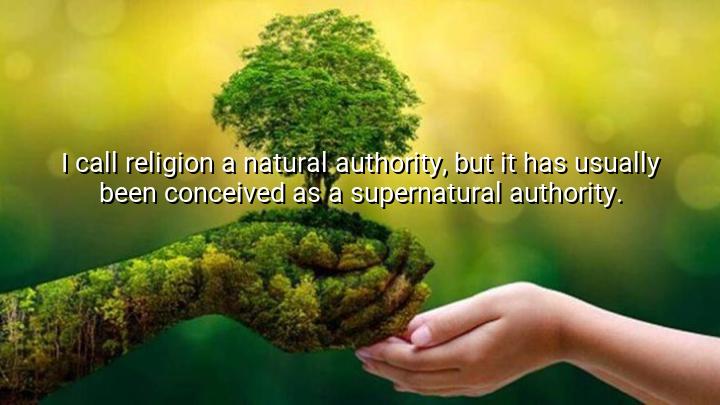




In this quote, Herbert Read distinguishes between two ways of understanding religion—as a natural authority versus a supernatural authority. He argues that religion should be seen as a natural force that arises from the human experience and consciousness, rather than something external or imposed by a supernatural power. By calling religion a natural authority, Read suggests that the moral, ethical, and spiritual principles of religion are inherent to human beings and their interaction with the world. Religion, in this view, is part of the fabric of human existence and not merely a set of rules dictated by a divine force.
Read's critique challenges the traditional view of religion as something that comes from beyond human nature, often represented as an authoritative, divine force that governs human behavior. In many religious traditions, supernatural authority is seen as coming from a higher power—whether God, gods, or other spiritual beings. This supernatural authority imposes rules and norms from outside human experience, and followers are expected to adhere to them. Read’s quote suggests that this conception of religion, while prevalent, overlooks the intrinsic role religion plays in shaping human understanding and community.
By describing religion as a natural authority, Read is also engaging with ideas of humanism and philosophy. He implies that religious principles should be rooted in human experience, not something extrinsic or alien to the individual. This reflects a more philosophical or existential approach to religion, where the focus is on the individual’s connection to the world and the moral laws that arise naturally from human reason and intuition, rather than through divine command. It places human experience and consciousness at the center of religious authority.
The origin of this quote comes from Herbert Read, a prominent British anarchist, philosopher, and art critic, who was known for his works that explored the relationship between art, culture, and society. Read was influenced by philosophical thinkers like Friedrich Nietzsche and Jean-Paul Sartre, who questioned traditional religious structures and emphasized the role of human autonomy in shaping belief systems. This quote encapsulates Read’s broader worldview, where he seeks to reframe religion as something that is deeply connected to human nature rather than something that is externally imposed by divine or supernatural forces.

AAdministratorAdministrator
Welcome, honored guests. Please leave a comment, we will respond soon