

The assumption is that the right kind of society is an organic being not merely analogous to an organic being, but actually a living structure with appetites and digestions, instincts and passions, intelligence and reason.
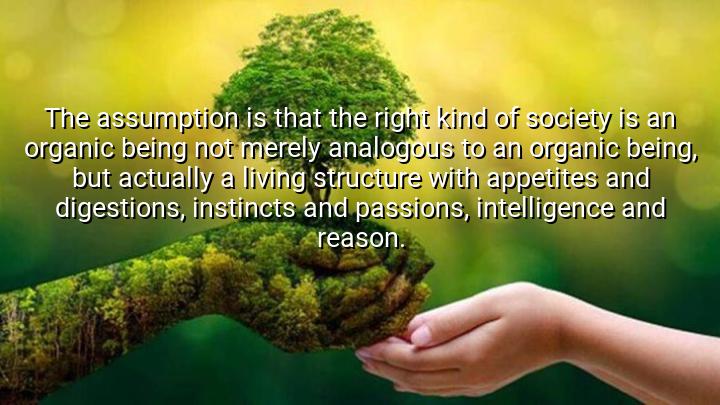




Herbert Read’s quote explores the concept of society as a living structure, one that is not just metaphorically similar to a living organism, but is, in essence, an organic being in its own right. He argues that society has its own appetites, digestions, instincts, passions, intelligence, and reason, much like a biological organism. This idea challenges the traditional view of society as a mere collection of individuals or a system of rules and structures, instead portraying it as a dynamic, evolving entity with its own life force and collective functions.
The reference to society having instincts and passions suggests that, like a living organism, society is driven by inherent forces that influence its development, behaviors, and responses to external stimuli. Similarly, intelligence and reason represent the more cognitive and deliberate aspects of society, where decision-making and problem-solving occur at the collective level. This vision portrays society not as a static or mechanical construct but as an ever-changing and reactive entity that is constantly adapting to internal and external forces.
Read’s ideas are influenced by philosophical and sociological theories that see the collective human experience as a complex, interrelated system, rather than a simple aggregation of individuals. By describing society in such terms, he emphasizes the need to understand the interconnectedness of people and institutions and the importance of recognizing society’s collective consciousness in shaping human life.
Ultimately, this quote encourages a more holistic and organic view of society, where individual actions and desires are interconnected with the broader collective behaviors and structures. It suggests that a well-functioning society must balance the emotional, instinctual, intellectual, and rational aspects of human nature, operating as a living, dynamic system rather than a static organization of laws and regulations.

AAdministratorAdministrator
Welcome, honored guests. Please leave a comment, we will respond soon