

I believe in the Prince of Peace. I believe that War is Murder. I believe that armies and navies are at bottom the tinsel and braggadocio of oppression and wrong, and I believe that the wicked conquest of weaker and darker nations by nations whiter and stronger but foreshadows the death of that strength.
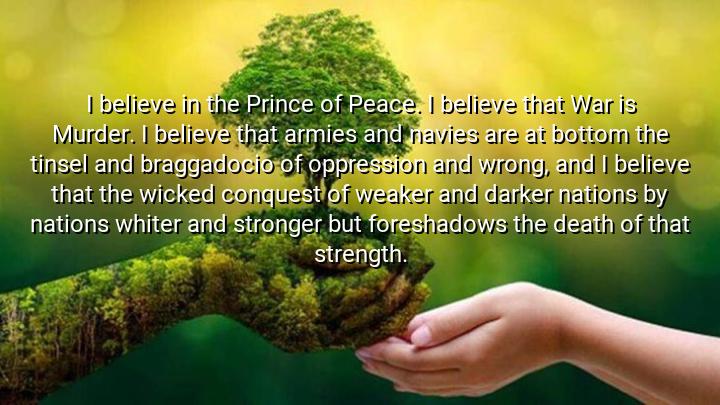




The quote by W. E. B. Du Bois, a prominent African-American scholar, activist, and leader, reflects his deeply held beliefs in peace, justice, and equality. Du Bois identifies himself as a believer in the Prince of Peace, a reference to Jesus Christ, symbolizing his commitment to nonviolence and peace. He goes on to equate war with murder, condemning the violence and destruction that come with conflict. For Du Bois, war is not a noble pursuit but an act of killing and harm, often justified by the powers that be for political and economic gain.
Du Bois also critiques the role of armies and navies, viewing them as the tools of oppression rather than instruments of protection. He refers to them as tinsel and braggadocio, suggesting they are mere displays of force and intimidation that mask the true violence and wrongs they are used to perpetrate. This highlights Du Bois’ belief that military forces often serve the interests of the powerful, reinforcing injustice rather than preserving order.
A key element of this quote is Du Bois’ condemnation of the conquest of weaker nations by stronger, often colonial, powers. He draws attention to the racial and economic dynamics at play in imperialism, where nations that are perceived as whiter and stronger exploit the weaker and darker nations. Du Bois suggests that this imbalance of power will ultimately lead to the downfall of the aggressors, as the violence and inequity they perpetuate foreshadow their own eventual demise.
The origin of the quote can be understood in the context of Du Bois’ broader intellectual and activist work. As a co-founder of the NAACP and a key figure in the civil rights movement, Du Bois advocated for human rights, racial justice, and the dismantling of imperialist systems. His critique of war and imperialism reflects his commitment to peace and his belief in the importance of creating a more just, equitable world.

AAdministratorAdministrator
Welcome, honored guests. Please leave a comment, we will respond soon