

He who is of calm and happy nature will hardly feel the pressure of age, but to him who is of an opposite disposition youth and age are equally a burden.
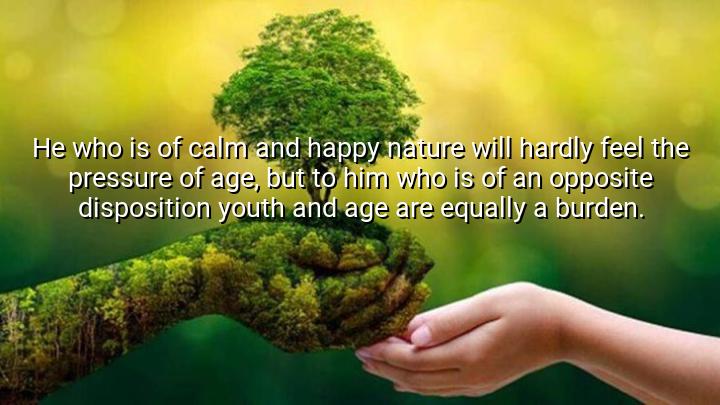




The quote "He who is of calm and happy nature will hardly feel the pressure of age, but to him who is of an opposite disposition youth and age are equally a burden" by Plato emphasizes the role of mental attitude in how we experience both youth and age. Plato, the ancient Greek philosopher, suggests that those who maintain a calm and content disposition are less affected by the challenges of aging. For them, the pressures of growing older are less burdensome because they have developed an inner peace and resilience that allow them to navigate life’s changes with ease.
Plato contrasts this with those who have a restless or discontented nature. For such individuals, both youth and age become burdens. In youth, they may feel the pressure of expectations, ambition, or insecurity, and in old age, they may struggle with regret, fear, or a sense of lost potential. Plato argues that the emotional and mental state of an individual greatly influences how they perceive and deal with the passage of time, showing that the mindset often determines whether age is a source of burden or contentment.
The idea presented by Plato suggests that happiness and calmness can act as buffers against the physical and emotional challenges that come with aging. These traits allow individuals to accept the natural progression of life, embracing both youth and old age with a sense of gratitude and understanding. This view aligns with many of Plato's teachings about the importance of inner harmony and the role of the mind in shaping our experience of life.
Ultimately, Plato’s quote reminds us that how we approach life—whether with calmness, contentment, and balance or with restlessness and discontentment—has a profound impact on our experience of both youth and age. A positive mindset allows us to navigate both stages of life with ease, while a negative disposition can make any period of life feel like a heavy burden.

KTKien Tran
This quote hits deep. It feels like a reminder that our perception of time and aging is more psychological than physical. But what about people who suffer from physical ailments or loss of independence in old age — can a positive mindset really buffer against that kind of hardship? Or is Plato being too idealistic here, assuming that inner peace can outweigh real-world suffering?
TPHoang Tien Pham
Plato’s idea here seems timeless, but it raises an interesting question for me: How much of our emotional disposition is shaped by society and environment versus individual choice? If someone grows up in chaos or hardship, are they more likely to experience both youth and age as burdens? Or can a person truly overcome their past and reshape how they perceive different stages of life?
MTNguyen Minh Thu
Does anyone else feel like this quote puts a lot of pressure on people to be cheerful and serene all the time? Not everyone has the luxury or mental capacity to feel calm or happy consistently. What about those struggling with depression or anxiety — are they doomed to suffer more from aging just because of their mental state? I wonder if Plato's thinking takes into account the complexity of modern psychological issues.
YNdo yen nhi
I really feel the truth in this quote. I’ve seen older people who are joyful and light-hearted, and younger ones who carry the weight of the world on their shoulders. It makes me wonder: is emotional well-being more crucial than physical youth? Why do we spend so much time worrying about aging when maybe we should be investing more in our mental outlook and emotional resilience instead?
HTHong Tran
This quote by Plato makes me reflect on how much our internal state affects our experience of life stages. Do you think it's possible to actively cultivate a calm and happy disposition, or is that more of a personality trait we're born with? If we can develop it, what practical steps can someone take to make peace with themselves and their life, regardless of age?