

Growing old is no more than a bad habit which a busy person has no time to form.
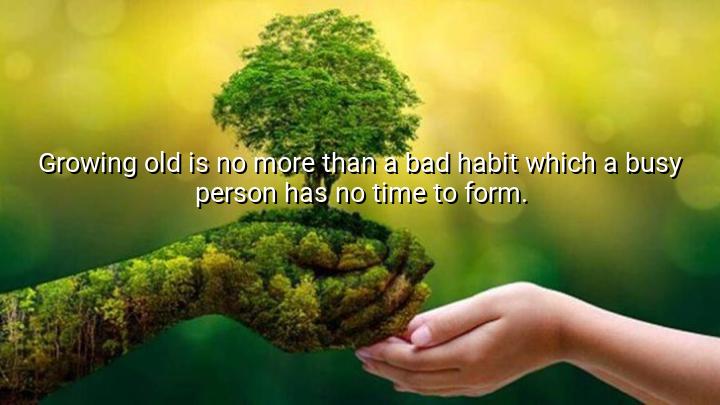




The quote "Growing old is no more than a bad habit which a busy person has no time to form" by Andre Maurois offers a playful and somewhat ironic perspective on aging. Maurois, a French author known for his witty and insightful writing, suggests that aging is not necessarily an inevitable or natural process but rather something that can be delayed or even avoided by staying busy and engaged in life. The idea of aging as a "bad habit" implies that it is a product of inactivity or lack of focus, and by remaining constantly involved in meaningful tasks, a person can avoid the stagnation that often accompanies getting older.
Maurois' quote emphasizes the connection between activity and youthfulness. He implies that when people remain engaged with their passions, careers, or hobbies, they don't have the time or energy to fall into the routine that leads to aging in the traditional sense. Instead of succumbing to the physical and mental decline often associated with aging, staying active and motivated can preserve a sense of vitality and purpose, thereby maintaining one's youthful spirit.
The concept of growing old as a "bad habit" suggests that aging is not a natural, uncontrollable process but something that happens when people become complacent or disengaged. Maurois contrasts this idea with the busy life of someone who is constantly challenged, curious, and purpose-driven, where the passage of time feels less significant. Busy people may not notice their physical decline as they are too absorbed in their endeavors.
Ultimately, Maurois' quote speaks to the idea that the key to staying young lies not in resisting age but in embracing activity and engagement. It suggests that youthfulness is a mindset that comes from staying active, involved, and focused on personal growth, rather than simply counting the years. This view promotes a more dynamic and proactive approach to life, where aging is not something that automatically happens, but something that can be postponed through constant engagement.

TBtrian bui
This line makes me smile, but it also makes me wonder—does modern society glorify busyness as a way to delay or deny aging? What about those who aren’t 'busy' due to illness, retirement, or personal choice—are they more susceptible to feeling old? Or is it more about staying curious and engaged with life regardless of activity level? I'd like to explore whether 'growing old' is about time or attitude.
PCY Pa Cu
I find this quote charming, but also a bit provocative. It implies that aging is more psychological than physical. Is there truth to that idea? Can staying mentally, socially, and emotionally active actually prevent us from feeling old? If so, how do we define what it means to ‘grow old’—is it about our bodies, our attitudes, or something else entirely? I’d love to hear different interpretations of this.
HAphan thao hien anh
It's a funny and almost rebellious take on aging, but it got me thinking: what if we framed aging not as a decline but as a shift in focus? Does being 'busy' just mean sticking to routines that keep us distracted, or does it refer to meaningful engagement with life? I’d love to hear perspectives on what kind of 'busy'—career, family, hobbies—actually helps us feel ageless.
NYDo Ngoc Yen
I love the wit in this quote, but I wonder if it oversimplifies the complexities of aging. Being busy might delay feelings of getting old, but doesn’t it also risk burnout or avoidance of deeper self-reflection? Is there a balance to strike between staying mentally engaged and also accepting the natural rhythms of aging? Maybe aging isn't a habit to break, but a process to embrace with awareness and purpose.
TTDau Thanh Tra
This quote makes aging sound like something we can almost avoid just by keeping ourselves preoccupied. But is that really true, or is it a clever way of saying that mindset shapes our experience of age? I'm curious whether being 'busy' actually preserves youth, or if it simply distracts us from noticing we're aging. Can staying active truly fend off the psychological effects of aging, or is it just a pleasant illusion?