

Globalization, as defined by rich people like us, is a very nice thing... you are talking about the Internet, you are talking about cell phones, you are talking about computers. This doesn't affect two-thirds of the people of the world.
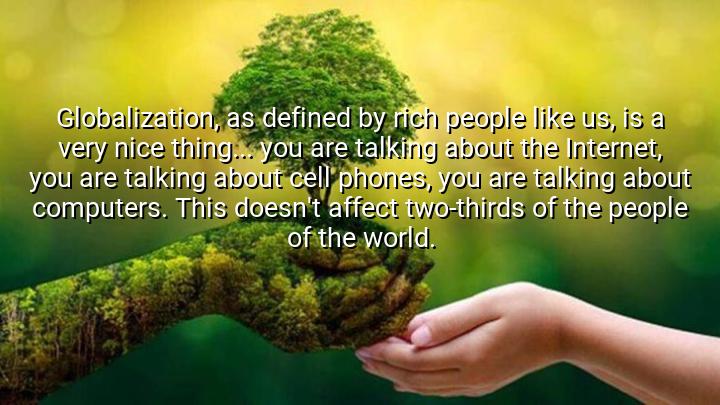




The quote by Jimmy Carter, "Globalization, as defined by rich people like us, is a very nice thing... you are talking about the Internet, you are talking about cell phones, you are talking about computers. This doesn't affect two-thirds of the people of the world," critically examines the disparity between the benefits of globalization for wealthy nations and its limited impact on poorer, developing countries. Carter suggests that while globalization has provided significant technological advances and conveniences for the wealthy, such as access to the internet and computers, much of the world’s population remains untouched by these advancements.
Jimmy Carter, the 39th President of the United States, has long been an advocate for human rights, social justice, and humanitarian causes. In this quote, Carter is pointing out the inequality that exists within the context of globalization. While it may be celebrated by those who have access to advanced technology and economic opportunities, it often overlooks or even exacerbates the challenges faced by people in developing countries, where many still lack access to basic technologies like the internet or cell phones.
The phrase "this doesn't affect two-thirds of the people of the world" highlights the stark contrast between the technological world of the privileged and the struggles of the majority of the global population. Carter is acknowledging that globalization, as experienced by wealthier nations, tends to benefit only a small portion of the world’s population, leaving the rest behind in terms of access to resources, technology, and opportunities. This observation underscores the inequities that exist within the framework of globalization.
Ultimately, Carter’s quote is a call to recognize and address the disparities in how globalization impacts different parts of the world. It challenges us to think critically about the benefits of globalization and consider how we can make its advantages more inclusive, ensuring that technological progress reaches everyone, not just the wealthy few.

AAdministratorAdministrator
Welcome, honored guests. Please leave a comment, we will respond soon