

Freedom is the recognition of necessity.
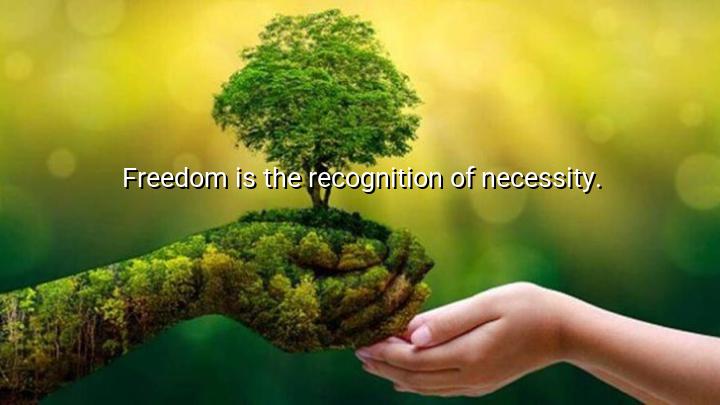




Friedrich Engels’ quote, "Freedom is the recognition of necessity," presents a thought-provoking view of what true freedom entails. Engels, a philosopher and close collaborator of Karl Marx, suggests that freedom is not the absence of all constraints but the understanding and acceptance of the necessities of life. In this context, necessity refers to the basic conditions and constraints that shape human existence, whether social, economic, or natural. By recognizing these limitations, individuals can act intentionally and freely within them, rather than being blindly constrained by them.
Engels argues that true freedom comes from an awareness of the forces that influence our lives and how we respond to them. Rather than seeing freedom as the ability to do anything without restrictions, he proposes that it is about understanding the underlying conditions—be they social systems, economic structures, or even natural laws—and working within or transforming them. Freedom, in this sense, becomes about empowerment and control over one’s circumstances, not in the form of total independence but in recognizing what is necessary for human life and acting accordingly.
The quote also reflects Engels' Marxist ideology, where the recognition of necessity is tied to the understanding of social and economic conditions. By recognizing the realities of class structures, labor, and production, one can better work toward creating a society where people can genuinely experience freedom, not in the idealized sense, but through collective effort and social change. Engels believed that only through recognizing the constraints of society could true liberation and freedom be achieved for all.
Ultimately, Engels’ statement redefines freedom as a process of awareness and conscious choice. It suggests that real freedom involves not escaping all constraints but engaging with and understanding the necessities that shape our existence, so that we can navigate them with purpose and agency. In this way, freedom becomes a dynamic and informed response to the realities of life, rather than an illusion of unlimited choice.

AAdministratorAdministrator
Welcome, honored guests. Please leave a comment, we will respond soon