

Freedom is not just declared; it is exercised.
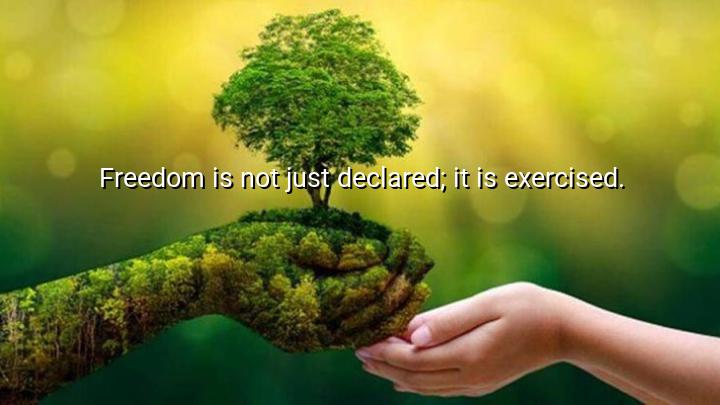




The quote by Ferdinand Marcos, "Freedom is not just declared; it is exercised," emphasizes that true freedom goes beyond simply proclaiming it or having it written into laws or constitutions. Marcos is suggesting that freedom must be actively practiced and lived out by individuals and society. It requires action and participation, not just recognition or symbolic gestures. Freedom involves making choices, taking responsibility, and engaging with the world in a way that reflects the rights and liberties granted to individuals.
In this context, Marcos highlights the difference between formal declarations of freedom and its actual implementation in daily life. While many nations or systems may claim to provide freedom, its real value is only realized when people are able to make decisions, express themselves, and engage in their rights without restrictions. Exercising freedom means actively participating in democratic processes, standing up for one’s rights, and ensuring that freedoms are not just theoretical but integral to the society in which they exist.
The origin of this quote is rooted in Marcos' tenure as the President of the Philippines. Marcos, who ruled from 1965 to 1986, declared martial law in 1972, a move that curtailed many freedoms. His statement reflects a belief that freedom must be both declared and practiced, which could be interpreted as a call for people to take responsibility for maintaining their own rights, even within a system that may limit them. In a sense, the quote could also be seen as an ironic commentary on his own actions, where he emphasized the idea of freedom while suppressing it through authoritarian measures.
Ultimately, Marcos' quote underscores the idea that freedom requires more than just rhetoric or legal guarantees. It demands active participation and engagement, with individuals and societies continually striving to live out the principles of liberty and justice. True freedom, as Marcos suggests, is not a passive concept but one that must be exercised and protected to remain meaningful.

AAdministratorAdministrator
Welcome, honored guests. Please leave a comment, we will respond soon