

Formerly, when religion was strong and science weak, men mistook magic for medicine; now, when science is strong and religion weak, men mistake medicine for magic.
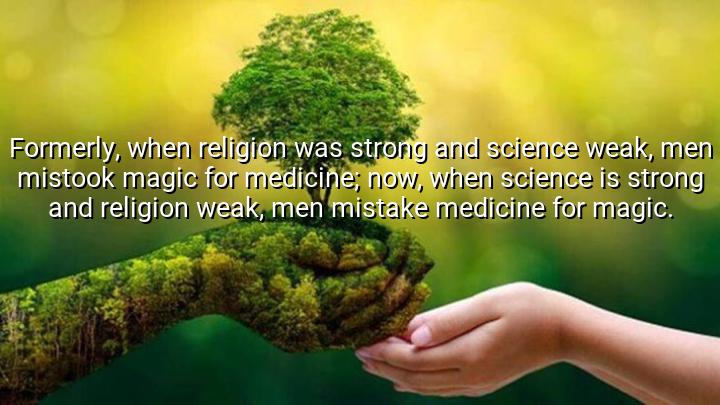




Thomas Szasz’s quote, "Formerly, when religion was strong and science weak, men mistook magic for medicine; now, when science is strong and religion weak, men mistake medicine for magic," highlights the shifting relationship between science, religion, and medicine throughout history. Szasz, a psychiatrist and critic of modern psychiatry, often examined the intersection of mental health, science, and social norms. In this quote, he suggests that as societal beliefs evolve, so does our understanding of medicine, and that in both past and present times, people often project mystical or magical qualities onto it, depending on the prevailing worldview.
In the past, when religion was the dominant force in society and science was still in its formative stages, many practices that we now recognize as medical were often misunderstood as magic or superstition. Without the modern understanding of biology and disease, early civilizations relied on spiritual or ritualistic healing practices that were tied to religious beliefs. People often saw healers as possessing divine or supernatural abilities, equating their remedies with magic rather than medical science.
However, Szasz draws a parallel to contemporary times, where science has advanced significantly, but religion has lost some of its influence in many cultures. He argues that in this modern era, people often treat medicine—particularly psychiatry and pharmaceuticals—with the same mysticism and blind faith that earlier societies had toward religious practices. Instead of seeing medicine as a rational, evidence-based discipline grounded in science, some view it as an almost magical solution, where prescriptions or medical procedures are seen as infallible without fully understanding their underlying principles.
Through this comparison, Szasz challenges us to consider how both science and medicine are shaped by cultural and philosophical contexts. His critique urges a more critical and thoughtful approach to medicine, emphasizing that it should be approached with the same skepticism and rationality that science demands. In essence, he warns that we should not allow the advancement of science to blind us to the limitations of medicine or to elevate it to a status of unquestionable authority, as we once did with religious figures and practices.

AAdministratorAdministrator
Welcome, honored guests. Please leave a comment, we will respond soon