

Every act of conscious learning requires the willingness to suffer an injury to one's self-esteem. That is why young children, before they are aware of their own self-importance, learn so easily.
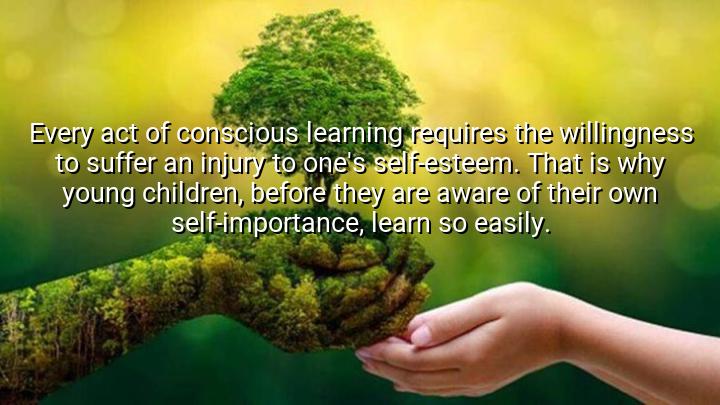




In this quote, Thomas Szasz highlights the psychological challenge that comes with learning. He suggests that every act of conscious learning requires an individual to step outside their comfort zone and be open to the possibility of failure or mistakes, which can hurt self-esteem. Learning often involves encountering uncertainty and discomfort, as individuals must acknowledge that they don't know everything and that growth comes from overcoming these challenges.
Szasz also contrasts this experience with that of young children, who, before developing a sense of self-importance, are more open to learning without the same fear of damaging their self-esteem. Children are naturally curious and willing to make mistakes, as they have not yet built up a fragile sense of their own worth based on success or failure. This lack of self-consciousness allows them to absorb new information and skills more easily.
The origin of this quote stems from Szasz’s work as a psychiatrist and psychoanalyst, where he often explored the complex relationship between the mind, mental health, and learning. In his writings, Szasz frequently discussed the importance of self-awareness and the obstacles people face when their sense of identity or worth is tied to their successes. His thoughts on learning reflect a broader critique of how people view themselves and how this affects their ability to grow and change.
Ultimately, Szasz’s quote underscores the psychological difficulty inherent in the learning process. To truly learn, individuals must be willing to face the discomfort of humility and vulnerability, acknowledging that mistakes are part of the process. By recognizing this, we can approach learning with more openness and curiosity, much like young children who are naturally inclined to explore without fear of damaging their self-worth.

AAdministratorAdministrator
Welcome, honored guests. Please leave a comment, we will respond soon