

For me, having a child is a really great responsibility because you've got something there that is depending on you for information and love until a certain age when it goes to school.
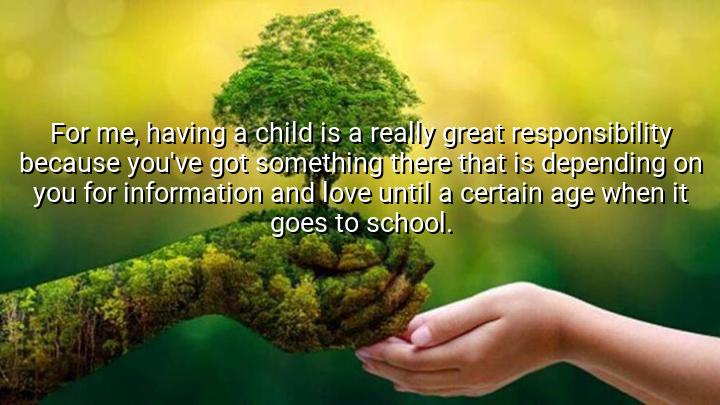




Kate Bush’s quote, "For me, having a child is a really great responsibility because you've got something there that is depending on you for information and love until a certain age when it goes to school," reflects the profound sense of duty and care that comes with parenthood. Bush emphasizes the importance of providing a child with the essential elements of growth—knowledge and emotional support—during their early years. This period of nurturing is critical, as children rely heavily on their parents for both intellectual and emotional guidance before they are exposed to broader influences like school and peers.
The quote underscores the significance of the early years in a child’s development, a time when parents are their primary source of information, affection, and security. Bush acknowledges that during this formative period, parents carry the heavy responsibility of shaping a child's emotional well-being and understanding of the world. The mention of school marks a shift, signifying that, as children grow, they start to encounter new sources of learning and socialization, which lessen the dependency on parents.
Kate Bush, a renowned British singer and songwriter, is known for her unique and often introspective music. In her work, Bush has explored themes of personal reflection, relationships, and human experience, and this quote offers a glimpse into her own perspective on parenting. Her recognition of the responsibility involved in raising a child highlights her thoughtful approach to the deeper aspects of life, including family and love.
In essence, Bush’s quote speaks to the fundamental role that parents play in a child’s early development. The information and love provided by a parent in the early years shape the foundation for a child's future. It reflects a deep sense of duty, acknowledging that the responsibility of caring for a child is both an immense challenge and a profound privilege.

TMHang Truong Minh
There’s something comforting and daunting in Kate Bush’s reflection. The idea that a child relies so completely on a parent before school starts is both empowering and scary. It makes me ask—are parents truly prepared for that role? And what about people who didn’t have that loving or informative presence early on? It really highlights the inequality of early childhood experiences and how they shape the rest of life.
YBYen Bui
This quote makes me think about how underestimated the early years of parenting can be. Society often talks about schooling as the beginning of ‘real’ learning, but Kate Bush reminds us that children are already absorbing so much before that. It raises the question: are we investing enough in early childhood—emotionally, socially, and structurally? Those first few years could make or break how a child approaches life.
BLthang bu lol
I appreciate how simply but powerfully this captures the intensity of early parenthood. There's something profound in realizing that a child looks to you for everything—for how to feel, think, and act. It’s humbling. But I also question the idea that this dependency fades when they start school. Isn’t it more of a shift in how they depend on you rather than an end to that responsibility?
TNNguyen Trong Nam
Kate Bush touches on something deeply human here—the sacred duty of raising a child. I find her focus on 'information and love' compelling. It makes me think about how much of a child’s worldview is shaped before they ever step into a classroom. What values and beliefs are we unconsciously passing down? And are we, as a society, doing enough to support parents during this formative phase?
TTnguyen thanh tuan
This quote really highlights how crucial those early years of parenting are. The idea that a child depends on you not just for physical care but also emotional and intellectual guidance is overwhelming but beautiful. I wonder, though, does the responsibility ever really stop? Even after school starts, don’t parents still serve as primary emotional anchors? It’s a powerful reminder of how foundational love and attention are in early development.