

For age is opportunity no less Than youth itself, though in another dress, And as the evening twilight fades away The sky is filled with stars, invisible by day.
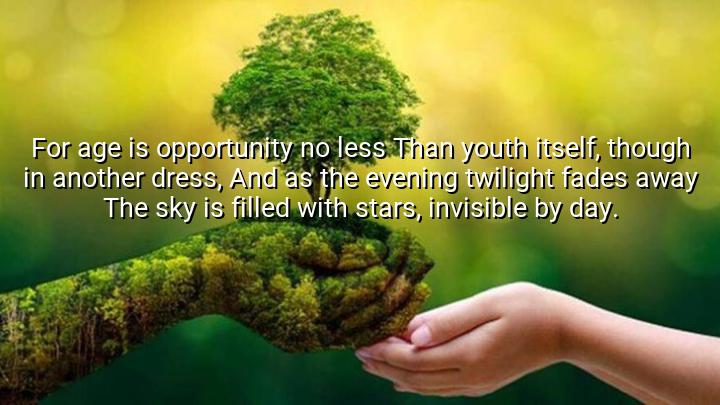




The quote "For age is opportunity no less Than youth itself, though in another dress, And as the evening twilight fades away The sky is filled with stars, invisible by day" by Henry Wadsworth Longfellow reflects a positive view of aging, suggesting that old age presents its own unique opportunities, just as youth does. Longfellow, an American poet known for his reflective and often optimistic works, compares old age to the twilight of the day, where new possibilities emerge that were not visible in the brightness of youth. He emphasizes that while youth may bring energy and potential, age brings a deeper wisdom and insight that can be just as valuable.
Longfellow’s reference to "another dress" suggests that the opportunities available in old age are different from those in youth but are no less significant. Just as the twilight of evening offers a different kind of beauty and perspective, old age offers a time for reflection, growth, and perhaps new kinds of achievement. The idea that age is an opportunity, not a limitation, encourages us to see aging as a stage of life where one can still pursue goals, find fulfillment, and make contributions.
The comparison to twilight fading and the sky being filled with stars represents the idea that as we age, new possibilities and opportunities can emerge—just as stars become visible only when the day ends. This imagery suggests that old age can bring about a different kind of illumination or clarity that was not accessible during the rush of youth. The stars in the sky represent the potential, beauty, and wisdom that can shine through in the later stages of life, often overlooked in the intensity of youth.
Ultimately, Longfellow’s quote challenges the common perception that aging is synonymous with loss or decline. Instead, it encourages a view of old age as a time of renewed opportunity, discovery, and value, much like the quiet and awe-inspiring beauty that the twilight hours bring to the evening sky. It reminds us that life continues to offer rich experiences and insights at every stage, and that age should be embraced as a time of continuing growth.

NLLe Nguyen Nhat Linh
This quote makes me reflect on how quickly we equate youth with value and forget that age has its own riches. The idea that twilight reveals stars really stuck with me—it suggests that what we gain later in life is not just different, but invisible to us when we’re young. Do you think we should be teaching this kind of perspective early on? Maybe it would help people fear aging less.
PNPhuc nguyen
I'm fascinated by the notion that age offers its own version of opportunity, just 'in another dress.' It’s elegant, but also practical. Why do we resist embracing new kinds of opportunity as we grow older? Is it ego? Or societal pressure to cling to youth? I'd love to know what specific opportunities people have discovered in midlife or later that they never expected before.
BCBeo Chuc
This quote feels deeply spiritual, almost meditative. I love the idea that certain qualities—like insight, patience, or even peace—are only visible with time, much like stars at twilight. But I wonder, do we need a certain mindset or life experience to even notice these 'stars'? What happens to those who fear aging or feel unprepared for its quiet gifts? It’s a comforting idea, but maybe not an automatic one.
NTNha Tran
Longfellow's imagery here gives me chills. It's so rare to see aging portrayed in such a graceful and empowering way. But how do we make sure people actually feel this in their day-to-day lives? It’s one thing to say aging is beautiful; it’s another to provide elders with purpose, dignity, and space to grow. I’d love to hear how others interpret this quote in their own lives or families.
TKtrung kha
What strikes me most here is the metaphor of evening and stars. It paints aging not as an end, but as a transition into a different kind of beauty. I'm wondering, though, in practical terms, how can we better support this 'opportunity' in aging? Are our systems—like retirement, healthcare, and social networks—really helping people discover and utilize this phase of life meaningfully?