

Family life is fragmenting in this modern age, but it's up to all of us to keep it together.
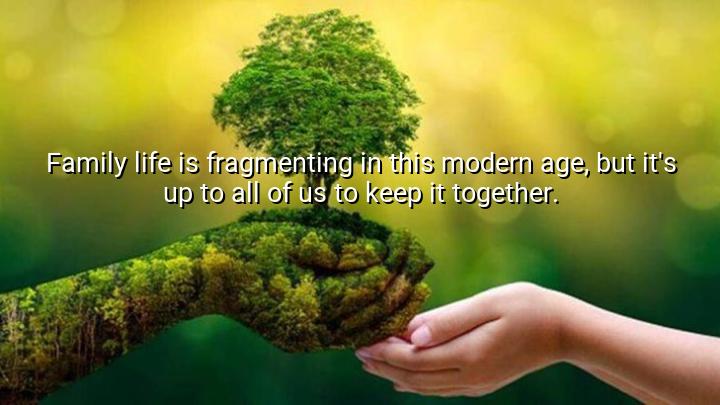




In this quote, Mary Berry, a renowned British food writer and television personality, reflects on the challenges facing family life in the modern age. She acknowledges that in today’s fast-paced, technology-driven world, family structures and relationships are becoming increasingly fragmented. However, she emphasizes that it is the responsibility of every individual to make a conscious effort to keep the family unit intact. Berry’s words call attention to the importance of maintaining strong, supportive family connections despite the distractions and pressures of modern life.
Berry’s statement underscores the challenges of modern life, where technological advancements, work commitments, and other external factors can place strain on family relationships. The fragmentation she refers to could encompass physical distance, emotional disconnection, or the erosion of traditional family dynamics. Despite these challenges, Berry stresses the importance of taking responsibility for nurturing and preserving family bonds. She calls on people to be intentional and proactive in maintaining these connections, whether through regular communication, quality time, or shared experiences.
The origin of this quote likely stems from Berry’s own experiences, both as a public figure and as a member of a family. Throughout her career, she has often focused on the importance of shared meals and family traditions, which serve as a reminder of the value of familial connections. Berry’s perspective on family life is rooted in her belief that even in the face of modern distractions, individuals can still prioritize and sustain meaningful family relationships.
Ultimately, Berry’s words encourage individuals to be more mindful of the role family plays in their lives and to take an active part in preserving it. In an age where family structures are evolving, her message is a call to recognize the importance of family as a source of support, love, and stability, and to make the effort to ensure it remains a central part of our lives.

PLHoang Phuong Linh
There's a nostalgic tone in this quote that I really relate to. It feels like a quiet plea to not let go of something sacred. And yet, I worry—are we clinging to an ideal that’s no longer realistic? With different lifestyles, cultures, and definitions of family today, maybe the goal isn’t to keep it together in an old-fashioned sense, but to redefine what togetherness means in modern times.
LULe Uyen
The quote raises an interesting point about shared responsibility. It’s not just parents or elders who should hold the family together—everyone plays a role. But how do you convince younger members, who may feel less rooted in tradition, to care about this? What approaches actually work in getting people across generations to invest in each other beyond just the holidays or emergencies?
Aanh-meme-meo-hai-huoc-7
This makes me think about my own family. We live in different cities, and schedules are always full, but maybe we’ve accepted too easily that that’s just the way it is. Are we letting modern life dictate our priorities? I’m wondering now—what traditions or routines could we revive or create to stay connected? Maybe it’s as simple as a weekly video call or writing letters.
NTNga Tran
I find this quote both hopeful and challenging. On one hand, it acknowledges a real issue that many of us feel—families growing distant, more individualistic. On the other hand, it puts the responsibility on all of us. That’s empowering, but also a bit overwhelming. What if you’re the only one trying to keep the family close? Is it still worth the effort when others don’t reciprocate?
GDGold D.dragon
I agree with the sentiment, but I wonder if the idea of a 'fragmenting' family is more complex than it seems. Yes, modern life brings distractions and distance, but it also brings new ways of connecting—FaceTime, group chats, virtual dinners. Maybe the definition of family unity just looks different now. Is the real challenge adapting our efforts to modern tools, rather than resisting the change entirely?