

Exposing children to nature, especially at an early age, keeps them grounded.
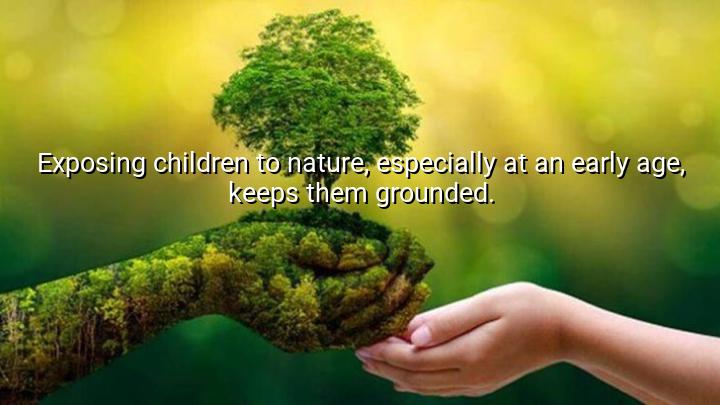




Roshni Nadar’s quote highlights the importance of exposing children to nature, particularly at a young age. By saying that it "keeps them grounded," she suggests that spending time in natural environments helps children stay connected to the world around them and develop a sense of balance and perspective. This grounding effect likely refers to the way nature can foster a deeper appreciation for life, instill calmness, and offer a sense of belonging that is less influenced by modern distractions.
Nadar emphasizes the idea that early exposure to nature shapes how children relate to their environment. By engaging with natural surroundings, children can develop a respect for the world beyond their immediate, human-made surroundings. This connection to nature may encourage more mindfulness, creativity, and even emotional intelligence as they learn to observe and interact with the natural world.
Additionally, the phrase "keeps them grounded" implies that nature provides a kind of stability and clarity that can help counterbalance the fast-paced, technology-driven world that children are increasingly immersed in. Nature, with its simplicity and inherent beauty, offers children a space to unwind and connect with something bigger than themselves. This can lead to greater self-awareness and well-being, as it encourages reflection and a deeper understanding of their place in the world.
Ultimately, Nadar’s quote advocates for the benefits of nature in childhood development. She underscores how early interaction with the natural world fosters essential qualities like resilience, emotional health, and a sense of connectedness, all of which help children grow into well-rounded, mindful individuals.

TQCao Thi Truc Quynh
I love the intention behind this, but it raises an important question for me: how do we balance structured education with unstructured time in nature? Schools are so focused on academic outcomes now—can they also play a role in making outdoor experiences a priority? Maybe nature-based learning models deserve more attention. Do we underestimate how much emotional intelligence and resilience can be developed outside the classroom walls?
TPPham trong phuc
There’s something really peaceful about this thought. In a world that’s becoming increasingly fast-paced and virtual, reconnecting with something as primal as nature feels like a solution we overlook. I’m curious though—at what age does nature have the most impact? Is there a critical window where it makes the biggest difference, or can introducing it later in childhood still offer grounding benefits? It seems worth exploring in developmental studies.
THLe Thu Hoài
It’s a lovely idea, but I wonder how inclusive it is. What about children in areas where access to nature is limited—either due to poverty, safety issues, or urban design? Does that mean they miss out on some critical form of personal development? I’d be interested in knowing how schools or community programs can fill this gap and whether virtual nature experiences have any comparable benefits at all.
LNNguyen Le Nguyen
This quote makes me nostalgic. I grew up catching frogs and climbing trees, and I do think it made a difference in how I see the world. But now I live in a big city, and my kids barely get outdoor time. Is it enough to just visit parks occasionally, or does the 'grounding' effect require something more immersive or consistent? I'd love practical ideas for nature exposure in urban environments.
IYIusj Y
I completely agree with this sentiment, but I wonder—what does being 'grounded' really mean in today's context? Is it about humility, emotional stability, or simply being less absorbed by digital distractions? With technology taking up so much of kids’ time, I’m curious if there’s research comparing long-term mental and emotional outcomes for children raised close to nature versus those in highly urban settings. Are schools doing enough to integrate nature into early learning?