

Every marriage tends to consist of an aristocrat and a peasant. Of a teacher and a learner.
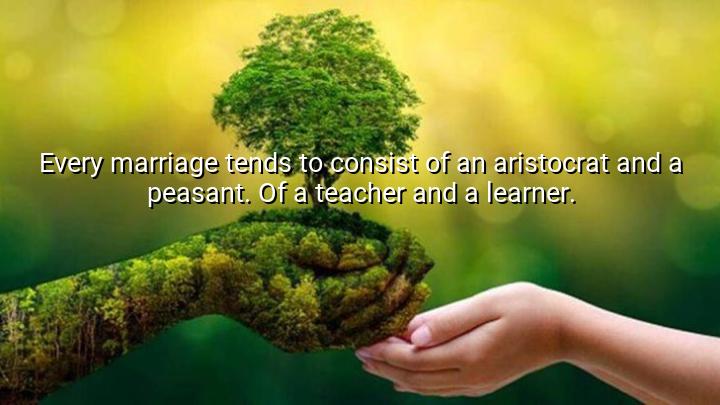




In this quote, John Updike, an acclaimed American author, uses metaphorical imagery to describe the inherent dynamics within most marriages. He suggests that every marriage is often composed of two people who, in some ways, play contrasting roles: one partner takes on the role of the aristocrat—the more dominant or authoritative figure—while the other becomes the peasant, more submissive or in a position of learning. Similarly, he likens these roles to that of a teacher and a learner, illustrating the unequal yet complementary nature of the relationship.
Updike’s comparison to an aristocrat and a peasant evokes a sense of power disparity within marriage, implying that one partner may hold more authority, wealth, or influence, while the other may be in a more dependent or humble position. The dynamic of a teacher and a learner further emphasizes this by suggesting that relationships often involve a natural give-and-take of knowledge, guidance, and growth. The quote points out that, despite the idea of equality in marriage, the reality often involves an asymmetrical exchange of power, wisdom, or experience between partners.
This idea also reflects the notion that relationships are inherently shaped by a series of roles that both partners assume, often subconsciously. Marriage, for Updike, is not just a partnership of equals, but rather a complex interaction where one person may take the lead at times, while the other follows or learns. The roles within a marriage can shift, as individuals evolve, but the foundational idea of one partner guiding or leading the other remains central to the structure.
Ultimately, Updike’s quote captures the subtle power dynamics that exist in most relationships, highlighting that marriage is often about the balance between dominance and submission, teaching and learning. It reflects the complexity of human relationships, suggesting that equality in a partnership is not a static state, but something fluid and evolving.

AAdministratorAdministrator
Welcome, honored guests. Please leave a comment, we will respond soon