

Every age, after all, must have its own aisling and dream of a better, kinder, happier, shared world.
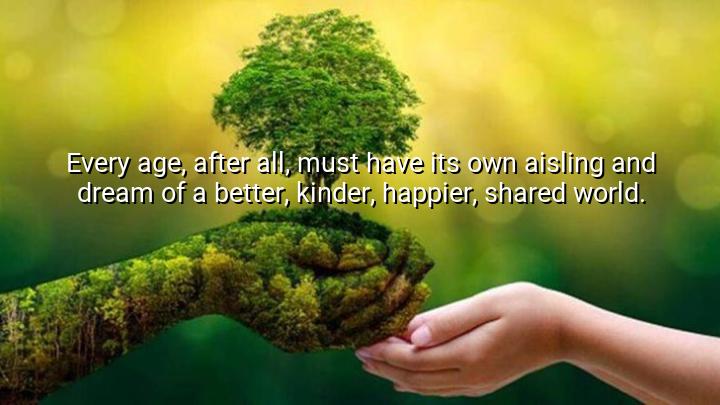




In this quote, Michael D. Higgins, the President of Ireland, speaks to the universal and timeless human longing for a better, kinder, and happier world. He suggests that every age or generation is defined by its own vision, or aisling, which is an Irish term that refers to a dream or vision of a utopian world. These dreams are driven by the hope for a more compassionate, inclusive, and harmonious society, a vision that resonates across different times and cultures.
Higgins’ use of the word aisling connects the quote to Irish literature and history, where aisling was often used to describe a dream or vision of Ireland’s future. By invoking this term, he links the idea of dreaming for a better world to Ireland’s rich tradition of imagining a more just and peaceful future. In this way, Higgins acknowledges that the desire for a shared world, where people are connected by kindness and mutual understanding, is a constant across human history.
The quote also highlights the notion that each generation is tasked with creating or working toward its own version of progress. Higgins implies that the pursuit of a better world is an ongoing, collective effort, shaped by the ideals and aspirations of those living in that particular age. Every generation's dream of a better world is different, but the essence of striving for improvement remains the same.
Ultimately, Michael D. Higgins’s quote serves as a reminder that the pursuit of a shared, better world is a deeply ingrained part of human nature. Each generation brings its own hopes and visions, driven by a collective desire to create a world that is more compassionate and fair. It’s a call to continue working towards these ideals, regardless of the challenges that each age faces.

QALuong Quoc Anh
This quote inspires me to reflect on the role of activism and leadership. If every age must have its own dream, then is it the responsibility of leaders and visionaries to articulate and pursue these hopes? And what about ordinary people—how can they participate in shaping and sustaining these shared dreams in their daily lives?
HTNGO NGOC HONG THUY
Michael D. Higgins uses the word ‘aisling,’ which is an Irish poetic tradition about visions or dreams. That adds depth to the quote, linking cultural heritage to universal longing. It makes me ask: how much do cultural contexts shape the specific nature of these dreams? Are some dreams more hopeful or inclusive than others depending on historical or social conditions?
Pphunghieu2808
This statement feels especially relevant in times of crisis. It’s comforting to think that every age, no matter how challenging, carries its own version of hope and aspiration. But I wonder—what happens when a generation’s dream doesn’t come to fruition? Does it pass on to the next generation, or do we risk losing that sense of shared possibility altogether?
HNHung Nguyen
I love the poetic tone of this quote—it reminds me that hope is a constant thread through history. But it raises a question: with so many competing visions of a ‘better world,’ how do we decide which dream to pursue? Can conflicting ideals coexist, or do they inevitably clash? How do societies balance individual hopes with collective needs?
HTNguyen Thi Ha Trang
This quote beautifully captures the timeless human yearning for progress and kindness. It makes me wonder how different generations define their own ‘dream’ or vision of a better world. Are the hopes of today’s youth vastly different from those of past eras? And how much do these dreams influence actual societal change, or do they remain mostly aspirational ideals?