

Equal rights for women. I agree with that concept. But we will never be free, we will never obtain equality, until we stop letting ourselves become pawns of the abortion industry. Our freedom depends on our rejection of abortion.
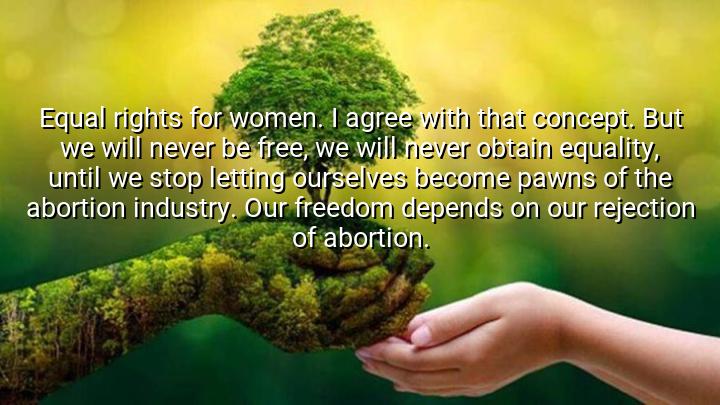




Abby Johnson’s quote, “Equal rights for women. I agree with that concept. But we will never be free, we will never obtain equality, until we stop letting ourselves become pawns of the abortion industry. Our freedom depends on our rejection of abortion,” reflects her stance on the intersection of women’s rights and abortion. Johnson, a former Planned Parenthood director who became an outspoken pro-life advocate, argues that while women’s rights are crucial, true equality cannot be achieved as long as women remain involved in what she perceives as the exploitative aspects of the abortion industry. For Johnson, the fight for freedom and equality involves rejecting abortion as part of the solution for women’s liberation.
The quote suggests that Johnson sees abortion as a tool that limits women’s freedom rather than empowering them. She believes that by participating in or supporting abortion services, women are being manipulated or controlled by an industry that profits from their decisions. In her view, abortion is not a liberating choice but one that, paradoxically, ties women to a system that undermines their equality and autonomy. Johnson’s perspective is rooted in her pro-life beliefs, which hold that abortion infringes upon the rights of the unborn and detracts from true empowerment for women.
For Johnson, the key to equality is not just securing legal rights but also rejecting what she sees as the harmful influence of the abortion industry on women’s freedom. She argues that women cannot be truly free or equal if they are complicit in an industry she believes diminishes their worth and undermines their potential. Her assertion that freedom depends on the rejection of abortion reflects her larger pro-life philosophy, which positions abortion as a moral and social issue, not just a political one.
Ultimately, Johnson’s quote is a call to rethink the relationship between women’s rights and abortion. It’s an appeal to those who advocate for equality to consider the impact of abortion on women’s true freedom and autonomy. Her argument is controversial, particularly in pro-choice circles, where abortion is seen as a vital aspect of women’s reproductive rights. However, for Johnson, freedom and equality can only be fully realized when women reject what she believes is a system that exploits them under the guise of empowerment.

AAdministratorAdministrator
Welcome, honored guests. Please leave a comment, we will respond soon