

Emancipation from the bondage of the soil is no freedom for the tree.
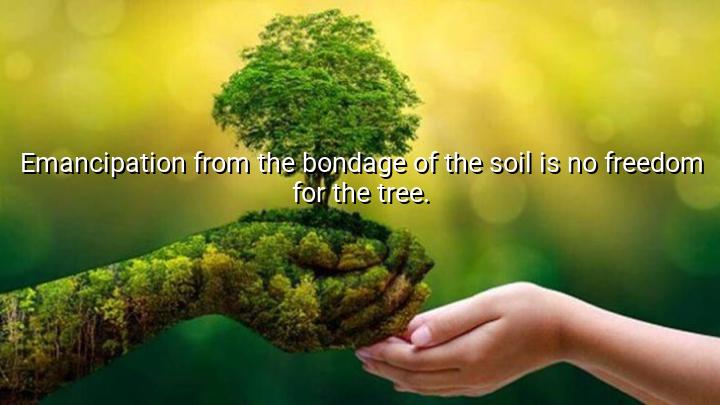




The quote "Emancipation from the bondage of the soil is no freedom for the tree" by Rabindranath Tagore uses the metaphor of a tree to explore the concept of freedom. Tagore suggests that while a tree may be freed from its connection to the soil, this does not equate to true freedom. The tree depends on the soil for its nourishment and survival. In this sense, true freedom involves more than just the absence of constraints; it requires the right conditions to thrive and grow.
The origin of this quote is found in the works of Tagore, who was a renowned Indian poet, philosopher, and Nobel laureate. His writings often explored themes of freedom, self-realization, and the relationship between the individual and society. In this particular quote, Tagore critiques a simplistic notion of freedom that overlooks the deeper interdependencies that are necessary for true flourishing. It reflects his belief that freedom cannot be defined merely by the removal of external restrictions but must also consider the context in which one can truly grow.
Tagore's metaphor highlights the idea that freedom must be holistic and conducive to growth. Just as a tree needs the soil for stability, nourishment, and growth, individuals or societies need foundational support and resources to fully experience freedom. Emancipation from one form of constraint might not lead to actual liberation if it disconnects them from the essential sources of nourishment and support required for their well-being.
Ultimately, this quote calls for a deeper understanding of freedom—one that recognizes the importance of interconnectedness and the need for supportive structures to enable true growth and flourishing. It serves as a reminder that freedom is not just about the absence of limitations but about creating the right environment in which individuals or entities can thrive.

AAdministratorAdministrator
Welcome, honored guests. Please leave a comment, we will respond soon