

Education is what survives when what has been learned has been forgotten.
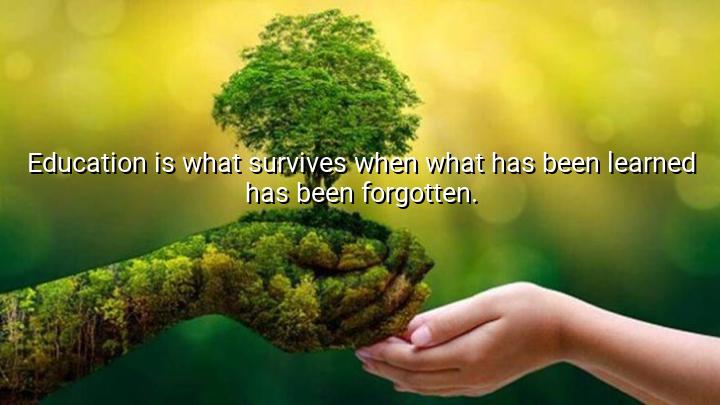




In the quote "Education is what survives when what has been learned has been forgotten," B. F. Skinner explores the enduring value of education beyond the mere retention of facts and information. Skinner suggests that while specific knowledge may fade over time, the core principles, skills, and critical thinking abilities developed through education remain with us. Education, in his view, is not just about memorizing information, but about cultivating the ability to adapt, solve problems, and think independently, even when the details may be forgotten.
Skinner’s insight speaks to the long-term impact of education. The facts or details that we learn in school might eventually slip from memory, but the deeper lessons of how to learn, analyze, and make sense of the world are what truly persist. The process of learning itself—how to approach problems, understand concepts, and critically evaluate information—becomes ingrained in us, shaping our ability to navigate life and make decisions long after specific lessons have faded.
This quote also reflects Skinner's broader philosophy on behaviorism, where he emphasizes the importance of learning and adaptation in shaping human experience. While traditional education systems often prioritize rote learning, Skinner highlights that true education is about nurturing abilities that can help individuals continue to grow and learn in different circumstances, even if the original information is forgotten. The focus shifts from memorization to transformation and personal development.
Ultimately, Skinner’s quote reinforces the idea that education’s true value lies in its long-lasting influence on our lives. It’s about the fundamental change it creates in how we think, adapt, and approach the world, rather than just the accumulation of facts. Education shapes us at a deeper level, and even when we forget what we’ve learned, its influence on our capacity to reason, act, and grow remains intact.

AAdministratorAdministrator
Welcome, honored guests. Please leave a comment, we will respond soon