

I did not direct my life. I didn't design it. I never made decisions. Things always came up and made them for me. That's what life is.
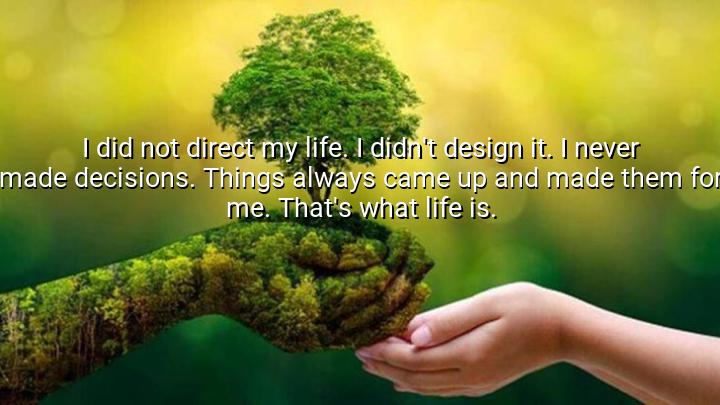




The quote “I did not direct my life. I didn't design it. I never made decisions. Things always came up and made them for me. That's what life is.” comes from B. F. Skinner, the American psychologist, behaviorist, and author, widely regarded as one of the most influential figures in behavioral psychology. In this reflection, Skinner presents a humble and almost deterministic view of life, suggesting that rather than being the product of deliberate choices, much of human experience is shaped by circumstances and external forces.
The meaning of the quote lies in its emphasis on the role of environment and chance in human development. Skinner downplays the notion of free will or personal design, instead acknowledging that life events, opportunities, and challenges often dictate the path we take. This perspective reflects his behaviorist philosophy, which argued that human actions are largely the result of conditioning and external stimuli rather than internal decisions. To Skinner, saying “things always came up and made them for me” reflects how environments guide behavior more than conscious planning.
The origin of this statement is tied to Skinner’s broader intellectual work in behaviorism and his personal reflections late in life. He developed theories such as operant conditioning, which highlighted how behavior is shaped by rewards and punishments, and he extended this logic to understanding broader human lives. By framing his own life as something he did not “design,” Skinner illustrates his belief that even his career and achievements were not so much the result of deliberate planning but of responding to circumstances and contingencies as they arose.
Ultimately, Skinner’s words reflect both personal humility and a philosophical position. They serve as a reminder that life often unfolds unpredictably, shaped more by the forces around us than by carefully laid plans. His quote captures the essence of a behaviorist worldview: that people are products of their environmental history, and understanding this dynamic is key to understanding both individual lives and the course of human behavior.

AAdministratorAdministrator
Welcome, honored guests. Please leave a comment, we will respond soon