

Education is the best provision for old age.
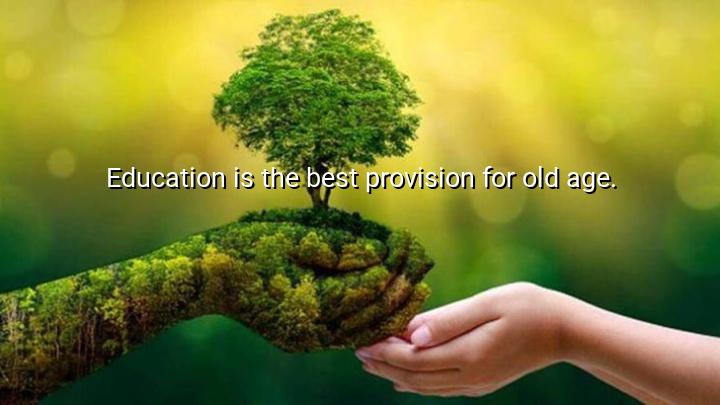




The quote "Education is the best provision for old age" by Aristotle emphasizes the value of learning and knowledge as a means of preparing for a fulfilling and productive life in later years. Aristotle, the ancient Greek philosopher, believed that education was essential not only for personal development during youth but also as a foundation for maintaining a vibrant and meaningful existence in old age. He suggests that lifelong learning and the cultivation of wisdom can provide individuals with the mental stimulation and purpose they need as they grow older.
Aristotle’s words imply that education is not simply about acquiring practical skills or information, but about developing the mind and fostering intellectual curiosity throughout one’s life. By continuing to engage with new ideas and seek understanding, individuals can keep their minds sharp and remain active in thought, which is crucial for mental well-being in older age. This type of mental engagement is a key factor in preserving one's vitality and adaptability, helping older adults avoid the stagnation or isolation that can sometimes accompany aging.
The phrase "the best provision for old age" suggests that instead of relying solely on material resources or physical health, education offers something more enduring and valuable: a rich and engaging life that extends well beyond the physical body. It allows individuals to remain connected to the world around them, offering opportunities for reflection, growth, and continued contribution to society. This makes education an essential investment for anyone wishing to maintain a fulfilling existence, no matter their age.
Ultimately, Aristotle’s quote encourages the idea that learning should be a lifelong pursuit, not something to be left behind as we grow older. It highlights the importance of intellectual curiosity and the role education plays in allowing people to face old age with confidence, engagement, and a sense of purpose. By viewing education as a lifelong endeavor, we are better equipped to navigate the challenges of aging with wisdom and a vibrant mind.

NLNguyen Lena
I agree with this sentiment, but I’d challenge it slightly. Education is undeniably important, but emotional well-being, relationships, and community support are also key to aging well. Maybe what Aristotle really meant was that a curious, educated mind can better navigate the challenges of aging. Still, how do we ensure that education doesn’t become a privilege that only some can use as a cushion in their later years?
TTNong Thi Thao
This quote immediately brings to mind the phrase 'knowledge is power'—but in this case, it's power over loneliness, irrelevance, and dependence. Learning new things, reading, and engaging in ideas can keep the mind sharp and the spirit young. Do we, as a society, recognize and support that enough? Or are we still treating education as a young person's game? I'd love to see more intergenerational learning environments thrive.
TKTakgoo Kim
There’s something quietly revolutionary about viewing education as a long-term investment in one's well-being. We often associate education with youth and early career prep, but this quote flips that script. Should governments and societies invest more in education programs tailored for seniors—not just for health literacy or tech use, but for curiosity and joy? What role does intellectual stimulation play in quality of life after retirement?
QTNguyen Quyet Tien
Is Aristotle suggesting that intellectual wealth is more enduring than material wealth? I think so. And I love that idea. While money may dwindle or become irrelevant with time, knowledge can give you purpose, confidence, and even social engagement in older age. It’s a powerful reminder not to stop learning, even when life gets busy. But how do we make ongoing education more accessible for aging populations?
MVle minh vu
I find this perspective timeless and incredibly practical. It makes me think about how education, beyond just formal schooling, empowers people to stay mentally active and financially secure as they age. But what happens to those who never had access to quality education early on? Can they still find meaningful ways to prepare for aging through learning later in life? Lifelong learning really feels more essential now than ever.