

Education in our times must try to find whatever there is in students that might yearn for completion, and to reconstruct the learning that would enable them autonomously to seek that completion.
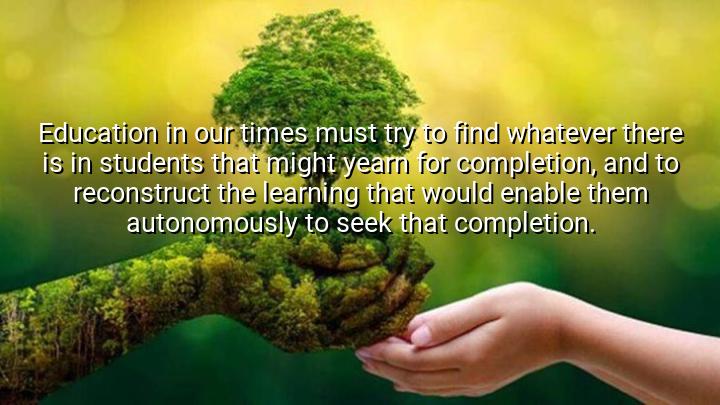




The quote by Allan Bloom emphasizes that education should focus on nurturing the innate potential and desires of students rather than merely transmitting information. Bloom suggests that educators must identify what in each student yearns for completion—a sense of personal growth, understanding, or fulfillment—and then design learning experiences that allow students to pursue that completion autonomously. This approach shifts the emphasis from rote learning to fostering independent intellectual development.
Bloom highlights the importance of self-directed learning in modern education. He believes that students should not be passive recipients of knowledge but active participants who take responsibility for their own intellectual journey. By reconstructing learning to meet the students’ personal needs and aspirations, education becomes a process that encourages curiosity, critical thinking, and the pursuit of meaningful knowledge.
The origin of this quote comes from Allan Bloom, an American philosopher and educator, known for his influential book The Closing of the American Mind (1987). Bloom critiqued modern educational practices that often neglect the cultivation of deep intellectual engagement. He advocated for a model of education that inspires students to seek knowledge and personal fulfillment, rather than merely following prescribed curricula.
In essence, Bloom’s quote underscores that true education is both personal and transformative. It is about guiding students to recognize and develop their inner yearnings and providing them with the tools and freedom to pursue completion in their own way, fostering lifelong learning and intellectual autonomy.

AAdministratorAdministrator
Welcome, honored guests. Please leave a comment, we will respond soon